Advertisement
Kenya and World Bank advance talks on Digital Superhighway programme
Tuesday 02nd June, 2026 06:10 PM|

Kenya’s digital transformation agenda advanced as government officials and a World Bank delegation assessed progress on the Kenya Digital Economy Acceleration Project (KDEAP), a Ksh50.5 billion initiative running from 2023 to 2028.
The meeting held on June 2, 2026, focused on implementation challenges and the pace of delivery under the first phase of the Digital Superhighway programme.
The session brought together ICT Authority Chief Executive Officer Jessy Maruti, Principal Secretary John Tanui, and a World Bank delegation led by Michel Rogy, Regional Practice Director for Digital Development for Africa and the Middle East.
Discussions centred on early operational bottlenecks, fund absorption, and acceleration of Phase One targets.
You Might Also Like



“The meeting was attended by a delegation from the World Bank led by Michel Rogy, Regional Practice Director for Digital Development (Africa and the Middle East). Discussions centred on addressing early operational bottlenecks, enhancing fund absorption, and accelerating the delivery of the phase-one targets that underpin Kenya’s Digital Superhighway agenda,” the X post read in part.
Broadband expansion and digital public services
Principal Secretary Tanui said the government had expanded broadband connectivity, strengthened digital public infrastructure, and widened access to digital services as part of efforts to build an inclusive digital economy. He said the initiatives were aimed at improving access and participation across all sectors.
ICT Authority officials present included Director of Programmes and Standards Thomas Bwaley, Director of Corporate Services CPA Richard Koech, and Acting Director of Partnerships, Innovations and Capacity Development Lynette Ringeera. The officials reviewed ongoing programmes supporting infrastructure rollout and service delivery under KDEAP.
Parliament updates on eCitizen and cybersecurity
In a separate engagement at Parliament Buildings, Cabinet Secretary William Kabogo Gitau appeared before the Senate Standing Committee on Information, Communication and Technology chaired by Senator William Kisang.
He reported that more than 22,000 public services are now available online through the eCitizen platform and related systems.
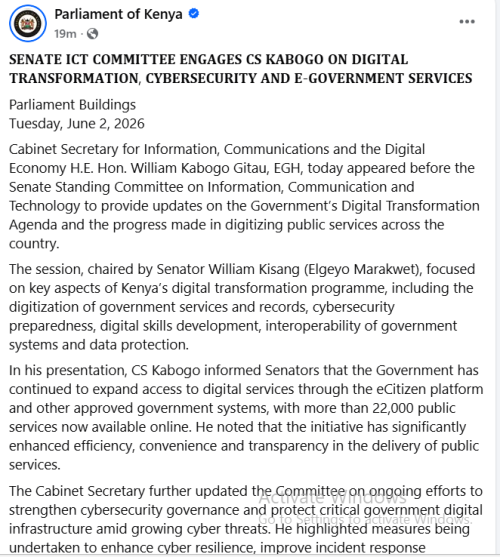
Kabogo outlined ongoing cybersecurity measures, including improved incident response systems and inter-agency coordination to address emerging threats. He also highlighted investments in digital skills training for public officers and citizens, as well as continued digitisation of government records to support paperless service delivery.
Senators raised concerns on digital inclusion, system interoperability, and the implementation of ICT projects across national and county governments.
Joint push toward digital economy goals
The two engagements underscored Kenya’s broader push toward a digitised economy combining infrastructure development, service digitisation, and policy oversight. The KDEAP programme is expected to support broadband expansion and digital infrastructure under the Digital Superhighway vision.
Officials said continued collaboration with the World Bank, alongside parliamentary oversight, would be key in addressing implementation challenges and achieving set targets. The government expressed confidence that ongoing reforms could strengthen service delivery and enhance digital access for citizens by 2028.
Author
Latest News







Advertisement
More on News