Kaluma: No room for abortion in Kenya, protect the unborn
By Faith Lagat, September 15, 2025Homa Bay Town Member of Parliament Hon. George Peter Kaluma has urged Kenyans to reject abortion amid what he described as rising trends and tragic incidents.
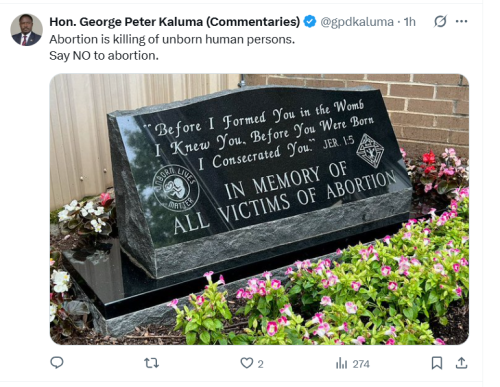
On Monday, September 15, 2025, Kaluma took to X to call on Kenyans to reject abortion, labelling it “the killing of unborn human persons.”
Accompanying his post was an image of a memorial stone inscribed with Jeremiah 1:5 — “Before I formed you in the womb I knew you” — alongside the words “In Memory of All Victims of Abortion.”
Kaluma’s statement, “Say NO to abortion,” reflects his firm stance against the practice and has sparked renewed debate across the country.
Abortion is illegal in Kenya. The 2010 Constitution offers limited protection, allowing abortion when a trained health professional determines that a woman’s life or health is at risk.
Shifts in abortion
Kaluma’s remarks come as new data from a study by the African Population and Health Research Center (APHRC), in collaboration with the Ministry of Health – Kenya and the Guttmacher Institute, reveals a significant shift in abortion demographics.
The report, titled National Study on the Incidence of Abortion and Severity of Complications in Kenya, challenges the long-held perception that abortion is primarily sought by young, unmarried women.
It finds that married women or those living with partners now account for the majority of induced abortion cases in Kenya, driven by financial strain, opposition to contraceptive use, and limited reproductive choice.
Released in 2023, the study reports that 304,159 women received care for post-abortion complications in health facilities that year. Nearly half (41.8%) of post-abortion care patients were aged 25–34, with more than three-fourths (78.6%) married or cohabiting.
Medication abortion remains the most common method, used by 62% of women, though 8% resorted to unsafe practices due to restricted access to legal services.
The incidence of induced abortions has risen from 48 per 1,000 women of reproductive age in 2012 to 57.3 in 2023, with access to post-abortion care improving from 12.0% to 18.5%.
However, gaps persist, with only 24% of referral-level facilities offering comprehensive post-abortion care. The report notes that 21% of expected facilities, particularly Level II and III, did not provide care, underscoring infrastructure challenges.
Dangers of unsafe abortion
Kaluma’s call to action follows a grim incident in Eldoret, where a 21-year-old female college student was found dead on Thursday, suspected to have died during a botched abortion. Police discovered a basin of blood and fetal remains in her rental house, prompting an investigation by Uasin Gishu Police Boss Benjamin Mwanthi.
The blood in the basin had pieces of flesh suspected to be those of a foetus. Uasin Gishu police boss Benjamin Mwanthi said residents reported the incident early on Thursday and police were called to the scene.
“We are investigating the cause of death of the woman at Tele View estate, and police have already visited the scene,” he said. The deceased was a second-year student at Eldoret Polytechnic, where she studied laboratory science.
In July, Nairobi Woman Representative Esther Passaris also shared a harrowing discovery of two lifeless, fully formed infants discarded on a roadside, questioning whether the tragedy stemmed from miscarriage or unsafe abortion.
The APHRC report highlights barriers to contraception and gaps in post-abortion care, recommending enhanced services and training to improve reproductive health outcomes.
Kenya’s 2010 Constitution permits abortion to save a mother’s life, but the Penal Code criminalises most cases, pushing women toward unsafe methods despite efforts under the National Reproductive Health Policy 2022–2032 to improve access.