Advertisement
Justice Philomena Mwilu: Elections thrive on trust, not just ballots
Thursday 09th July, 2026 03:31 PM|
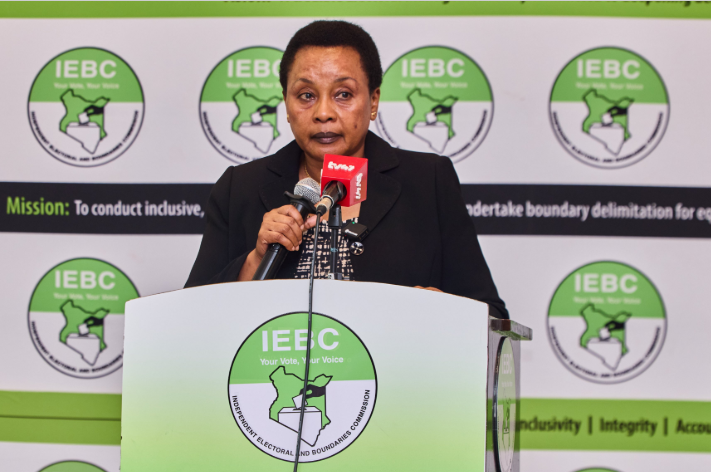
Deputy Chief Justice Philomena Mwilu has said the credibility of elections depends not only on the casting of ballots but also on public confidence that every stage of the electoral process is conducted fairly, lawfully and transparently.
In a statement shared on X account on Thursday, July 9, 2026, during the launch of the Independent Electoral and Boundaries Commission (IEBC) Pre-Election Dispute Resolution (Pre-EDR) Report and Case Digest, Mwilu said electoral justice is fundamental to safeguarding democracy and maintaining citizens’ trust in the country’s electoral system.
“Elections are not sustained by simply casting ballots, but by the confidence of citizens that every stage of the electoral process is governed by law, administered fairly, and subject to impartial review where disputes arise,” Mwilu said.
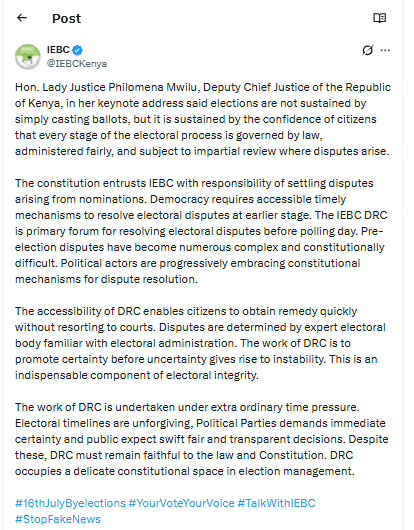
She noted that the Constitution places the responsibility of resolving disputes arising from nominations on the IEBC, making the Commission’s Dispute Resolution Committee (DRC) a critical institution in protecting electoral integrity before polling day.
Early dispute resolution key to democracy
You Might Also Like



Mwilu observed that pre-election disputes have become increasingly numerous, complex and constitutionally challenging, saying political actors are gradually embracing constitutional mechanisms instead of resorting to other avenues to settle disagreements.
She said accessible and timely dispute resolution mechanisms help citizens obtain justice without unnecessary court battles while ensuring certainty before elections.
“The accessibility of the DRC enables citizens to obtain remedy quickly without resorting to courts. The work of the DRC is to promote certainty before uncertainty gives rise to instability. This is an indispensable component of electoral integrity,” she stated.
The Deputy Chief Justice acknowledged that the committee operates under immense pressure due to strict electoral timelines and public expectations for swift decisions.
“Despite these extraordinary pressures, the DRC must remain faithful to the law and the Constitution. It occupies a delicate constitutional space in election management,” she added.
IEBC pushes reforms ahead of 2027 polls
Mwilu’s remarks came as the IEBC unveiled proposals aimed at reducing nomination disputes ahead of the 2027 General Election.
Among the reforms contained in the Commission’s Pre-Election Dispute Resolution Report is a proposal to extend the period for determining pre-election disputes from 10 days to 14 working days.
The electoral agency has also proposed extending the deadline for filing complaints from 24 hours after a dispute arises to 72 hours after the close of candidate registration to give aggrieved parties adequate time to prepare their cases.
Strengthening electoral integrity
The Commission further wants the law harmonised to eliminate conflicting interpretations of “nomination” and “party nomination,” which it says have contributed to litigation during past elections.
It has also proposed stricter proof of resignation for public officers seeking elective positions and enhanced civic education for aspirants before nominations begin.
The proposed reforms are intended to strengthen the credibility of party nominations, minimise avoidable disputes and improve the efficiency of electoral dispute resolution as Kenya prepares for the 2027 General Election.
Author
Latest News







Advertisement
More on News