Advertisement
It’s the State’s duty to protect citizens from dubious vaccines and ban on privately procured ones was right
Monday 05th April, 2021 02:42 AM|
By MILAN KIPLAGAT
The rollout of the lifesaving Covid-19 vaccines in the country has attracted unnecessary controversy and, sadly, been immersed in the endless politicking that has been the bane of programmes meant to address the needs of the citizenry.
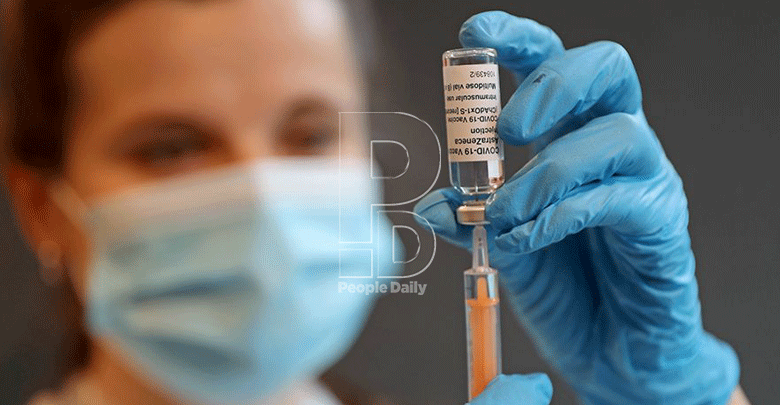
This is after Deputy President William Ruto became the second Kenyan after prominent lawyer Ahmednassir Abdullahi to be injected with Russia’s Sputnik V. This despite President Uhuru Kenyatta leading members of Cabinet and senior government officials to take the AstraZeneca Plc vaccine, which has been ratified by both the World Health Organisation (WHO) and the Africa Centres for Disease Control and Prevention (Africa CDC).
The manner in which the Russian vaccine, whose efficacy reputable global health experts have questioned, was imported by private sector players was itself suspicious.
And so was the public endorsement by Ruto, Abdullahi and another prominent lawyer Donald Kipkorir.
It was apparent that some players were out to make a kill by exploiting public anxiety to make obscene profits but doing so in a manner that did not raise any suspicions.
While the Russian embassy in Nairobi disowned the imports from Moscow, Kenya using the laid down international mechanisms has already received a total of 1.1 million AstraZeneca Plc doses from the Covax initiative. This is in addition to another consignment donated by the Indian government.
The vaccine, which is being offered through the ministry of Health and other public facilities, is ideal for ordinary citizens since it is free of charge.
While the available doses are a drop in the ocean, they provide a milestone promise for a better tomorrow following an otherwise difficult year in dealing with the ravages of the Covid-19 pandemic, as recently noted by WHO.
This is because the Covax facility is a global initiative working with governments and manufacturers to ensure Covid-19 vaccines are available worldwide to both higher-income and lower-income countries.
The AstraZeneca-Oxford vaccine was manufactured by the Serum Institute of India (SII) and made available to the Covax facility thanks to an advance purchase agreement between Gavi, the Vaccine Alliance and SII. The doses were procured and transported by UNICEF’s Supply Division in Copenhagen.
The consignment already received by Kenya is part of an initial allocation to Kenya of 3.56 million doses. In addition, Covax is providing 1,025,000 syringes and 10,250 safety boxes to the country via a global stockpile funded and supported by Gavi. Kenya, however, already has enough in-country stocks of syringes and safety boxes for the first phase of vaccinations.
On Saturday, the National Emergency Committee on Coronavirus noted that the AstraZeneca vaccine is being made available to the public not just through the Covax facility but also through the Africa CDC and bilateral platforms as opposed to the Russian vaccine.
The Pharmacy and Poisons Board had allowed private sector imports on the basis that Covid vaccines were being hoarded on the world market and yet the country was keen to ensure they were readily available even outside the priority groups such as security officers, teachers and persons over 58 years of age.
But as the committee pointed out, unregulated private sector imports not only threatens the gains made in the fight against Covid-19 but also puts the country at international risk should counterfeit products gain entry into the local market.
Since the safety of the Russian vaccine is yet to be subjected to international protocols, the government was, therefore, right to warn that there was a need to urgently close the window for private importation of Covid vaccines in order to ensure transparency and accountability in the programme.
Even worrisome was the obscene profits the importers stood to rake in from selling the vaccine, which was going for an average of Ksh 8,000 per dose.
The government was thus right to not only align the country to global Covid 19 procurement mechanisms but also to protect Kenyans from exploitation.
It is a pity that the ban on private sector imports has been taken by the DP’s surrogates as targeting him. The fallacy is that there is a plot to use the Covid vaccines as a political weapon and that part of it involves ensuring he does not get a second dose of the Russian vaccine.
Author
People Daily
View all posts by People DailyLatest News







Advertisement
More on News