Advertisement
Israel threatens takeover of historic Solomon’s Pools near Bethlehem
Sunday 19th July, 2026 01:40 PM|
Israel is threatening to seize ancient water reservoirs near Bethlehem, in what would be a significant escalation in an intensifying campaign for control of West Bank land and the Middle East’s historical narrative.
Since Israel’s extremist finance minister, Bezalel Smotrich, made an explicit threat in May to “erase” the agreements that confirmed Palestinian ownership of Solomon’s Pools more than 30 years ago, Israeli settlers and troops have stepped up their presence around the spectacular site.
The pools date back as far as the second century BCE, though the main construction was carried out by the Romans a century later as part of a vast engineering project of two reservoirs, aqueducts and tunnels to supply water to Jerusalem 8 miles (13km) away.
A third monumental basin was added under Ottoman rule, when a fort was also built to safeguard the water supply. During the Mandate period from 1923 to 1948, the British authorities modernised the system with metal pipes and pumps.
You Might Also Like


The pale stone Mandate-era pumping station now stands abandoned in the wooded hills of the area and the pools, more than 10 metres deep in places, no longer funnel water to Jerusalem, but have become the main source of recreation in the area.
Growing tensions around the historic site
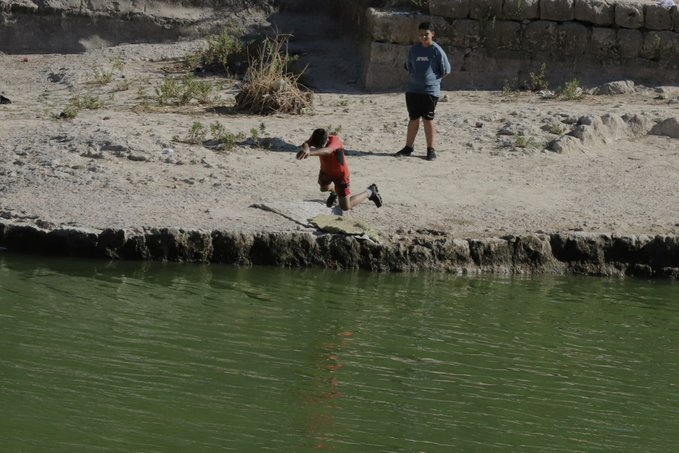
On a recent afternoon, children from the neighbouring villages of Artas and al-Khader took running jumps off the stone walls of the middle pool into the deep green water, while a handful of men fished amid the reeds off the ramparts on the other side.
On Fridays and holidays, families come from Bethlehem, 2 miles (3.5km) to the north-east, to spend the evening, bathe and picnic. As the city has become hemmed in by new settlements on all sides, the pools are increasingly a sanctuary for Bethlehemites.
“It’s the only place now in all Bethlehem that you can find somewhere to sit and to enjoy the water, the shade, the green space – and now they are trying to steal it,” said Mahmoud Jaber, a local activist and horticulturist from Artas, who uses water from the local springs to grow vegetables.
Although a district of the Efrat settlement looms above the pools, they only came under immediate threat in May when Smotrich and another hardline Israeli politician, Zvi Sukkot, had police drive Palestinians away from the area so they could be filmed swimming in the middle pool.
“This is our land,” Smotrich declared, and Sukkot echoed his call for Israel to take over the site. Since then, incursions from settlers have become more frequent and on 10 July Israeli soldiers carried out an unprecedented raid, firing teargas while children swam in the pools.
The pressure campaign has sparked outrage in Palestine not just because of the archaeological importance of the three rectangular pools which – with a combined capacity of 250,000 cubic metres – constitute one of the biggest water systems surviving from the ancient world. It also represents a new frontal assault on the Palestinian Authority (PA).
Oslo Accord at the centre of dispute
Under the second Oslo Accord of 1995, Solomon’s Pools was made part of the wider Bethlehem area classified as Area A, under Palestinian civil and police control. The division of the West Bank into areas A, B (Palestinian civil and Israeli military control), and C (full Israeli administration) was intended to be a halfway stage to eventual Israeli withdrawal from the occupied territory and the creation of a Palestinian state.
That aim has long since been renounced by the prime minister, Benjamin Netanyahu, and his far-right coalition, who have accelerated the spread of Israeli settlements across the West Bank in an attempt to cripple an independent Palestine at birth.
Throughout that years-long campaign, Area A has mostly been considered inviolable, until a security cabinet edict in February this year asserting Israeli control over the Rachel’s Tomb historical site inside Bethlehem. The seizure of Solomon’s Pools would set a further precedent, suggesting that parts of Area A could be appropriated at will in ad hoc decisions by ministers.
When he visited the pools in May, Smotrich said that leaving such a “magnificent ancient water site” under Palestinian control had been “one of the terrible mistakes” of the Oslo Accords.
“We are working hard to repair the terrible damage caused by the Oslo Accords disaster,” he said.
“This site is being weaponised in order to erode and basically cancel the Oslo agreement,” said Alon Arad, an Israeli archaeologist and executive director of Emek Shaveh, an organisation set up to protect ancient sites. He added: “There are 6,000 ancient sites in West Bank and only a [fraction] out of them represent any connection to Jewish heritage.”
Competing historical claims
It is not clear if and when the Israeli coalition will try to seize Solomon’s Pools, but archeologists and local Palestinians are braced for more incursions as Israel’s October elections approach. Meanwhile, the justification for a takeover has been laid down by hardline Israeli propagandists, who argue that the PA has allowed Solomon’s Pools to fall into disrepair. The site is crumbling in some places and a few patches of discarded water bottles and other litter could be seen in one corner of the middle pool.
The PA Waqf, the religious endowment which owns the site, had ambitions to develop it for tourism, but those aspirations were crushed when Smotrich withheld the PA’s tax and excise revenues, starving it of funds.
The other rationalisation advanced for an Israeli takeover is that Solomon’s Pools is uniquely Jewish. Writing on the Jerusalem Center for Security and Foreign Affairs website earlier this month, reserve Lt Col Maurice Hirsch said that the site was “by its very name, of Jewish historical significance and importance”.
Solomon’s Pools, however, is a historical misnomer. King Solomon, if he existed (a subject of debate), is thought to have ruled Israel and Judah about 800 years before work started on the reservoirs.
The first two pools were built in the time of another Jewish king, Herod the Great, a Roman client ruler, but like many ancient sites in Israel and Palestine, Solomon’s Pools show the overlain traces of successive eras and empires.
Local Palestinians maintained the name over the centuries, but Eman al-Titi, the head of Bethlehem’s tourism and antiquities department, said it came to refer to the Ottoman sultan, Suleiman the Magnificent, who restored Jerusalem’s walls and water supply in the 16th century.
“Archaeological sites should never become instruments of political conflict,” al-Titi said. “This issue extends beyond control of the land itself. It also involves attempts to reshape history and promote a single historical narrative that does not reflect the archaeological evidence or the many civilisations that have contributed to Palestine’s rich cultural heritage over thousands of years.”
Author
Latest News







Advertisement
More on News
