Inside govt’s 30-year recruitment plan transforming Kenya’s public service workforce by 2055
By Aloys Michael, July 24, 2026Kenya is laying the groundwork for what could become the most significant transformation of its public service in decades, with the government developing a long-term recruitment and workforce renewal strategy designed to reshape state institutions through 2055.
Unlike previous reforms that focused on immediate staffing needs, the proposed Public Sector Transformation Policy seeks to align government recruitment with demographic trends, retirement patterns and future skills requirements. The policy is expected to guide how ministries, departments and state agencies recruit, train and replace employees over the next 20 to 30 years, creating a roadmap for a younger and more technology-driven public service.
Public Service Cabinet Secretary Geoffrey Ruku says the reforms are intended to prepare government institutions for the future rather than trigger immediate changes to the current workforce.
“The Ministry of Public Service is committed to public sector transformation reforms. These reforms are gradual and well thought out. We are developing a Public Sector Transformation Policy guided by data on the existing gaps in public service, the skills available and the age profile of the workforce,” Ruku said while unveiling the government’s plans.
He added that the strategy is anchored on evidence collected through an ongoing assessment of staffing levels across government institutions.
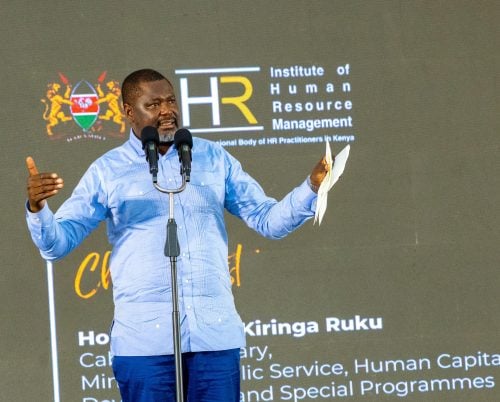
“Because we are a young nation, we want to ensure the Gen Z-ification of the public service. The policy will identify the gaps we have in public service and the appropriate measures the government will undertake over a period of not less than 20 to 30 years,” he said.
The announcement marks a shift from short-term recruitment toward long-range workforce planning, an approach increasingly adopted by governments seeking to respond to changing demographics, rapid technological advancement and evolving citizen expectations.
Kenya’s public service has for years faced the dual challenge of an ageing workforce and rising demand for specialised skills, particularly in information technology, digital governance, engineering, healthcare, environmental management and public finance.
At the same time, universities and colleges continue to produce thousands of graduates annually, many of whom struggle to secure formal employment despite possessing qualifications that could support public sector modernisation.

The proposal
The government’s proposal seeks to bridge that gap by ensuring workforce renewal happens gradually as experienced employees retire, allowing institutions to preserve institutional memory while bringing in professionals equipped with emerging skills.
The strategy is also consistent with broader demographic realities. Kenya remains one of Africa’s youngest nations, with a large share of its population below the age of 35. This youth bulge has been described by economists as both an opportunity and a challenge.If adequately employed, it can accelerate economic growth through what is known as the demographic dividend. If employment opportunities fail to keep pace with population growth, however, the country risks rising unemployment and underutilisation of skilled labour.
Research by the World Bank has consistently shown that countries with younger populations can unlock stronger economic growth when they invest in education, skills development and productive employment. Similarly, the Organisation for Economic Co-operation and Development (OECD) has found that strategic workforce planning enables governments to anticipate future skills shortages, improve succession planning and strengthen the delivery of public services instead of reacting only after vacancies emerge.
These trends have prompted governments around the world to rethink how they recruit, retain and develop public servants. Countries such as Singapore, Canada and the United Kingdom have increasingly integrated digital skills, data literacy and innovation into civil service recruitment as governments adapt to technology-driven service delivery and growing public demand for efficient institutions.

Gen Z in the labour market
Kenya’s proposed reforms appear to follow the same long-term thinking by placing workforce planning at the centre of public service transformation.
While the phrase “Gen Z-ification” generated public attention following Ruku’s remarks, government officials have stressed that the policy should not be interpreted as an immediate replacement of older employees. Rather, it reflects a succession planning model where workforce renewal occurs naturally over several decades as employees retire and recruitment priorities evolve.
“The policy will identify the gaps we have in public service and the appropriate measures the government will undertake over a period of not less than 20 to 30 years,” Ruku reiterated.
The emphasis on data-driven planning represents another notable departure from previous approaches. According to the ministry, the policy is being informed by a comprehensive assessment of employee age profiles, existing competencies and staffing shortages across government institutions. Such workforce mapping is intended to help policymakers determine where future recruitment should be concentrated and what new skills will be required as public administration becomes increasingly digital.
Experts in public administration have long argued that workforce planning is critical to maintaining effective government institutions. The United Nations has previously observed that modern public services must continually adapt to technological change, changing citizen expectations and demographic transitions, requiring governments to invest in continuous learning and long-term human resource planning rather than one-off hiring exercises.
If successfully implemented, the proposed reforms could influence nearly every aspect of Kenya’s public service, from recruitment and promotions to leadership succession, training and professional development. Greater emphasis is also expected to be placed on digital competencies, data analysis, innovation, project management and service delivery as government agencies expand the use of technology.
For university graduates and young professionals, the policy signals that future opportunities in government may increasingly favour skills aligned with digital transformation and evidence-based policymaking.
However, the strategy does not amount to an immediate recruitment programme. Employment into the public service will continue to depend on available vacancies, budgetary allocations, constitutional requirements and competitive recruitment processes.
The government’s long-term approach also reflects a recognition that transforming institutions cannot be achieved through periodic recruitment alone. Sustainable reform requires balancing experience with innovation, preserving institutional knowledge while preparing a new generation of public servants capable of responding to increasingly complex national challenges.
The Public Sector Transformation Policy is still under development, and its recommendations will be refined once the government’s workforce assessment is complete. Once adopted, it is expected to provide a framework for recruitment, succession planning, skills development and workforce renewal across ministries, departments and agencies for the next two to three decades.
Whether the strategy ultimately succeeds will depend on consistent implementation, adequate funding, transparent recruitment practices and sustained investment in training.
But if the government’s vision is realised, the decisions made today could determine what Kenya’s public service looks like in 2055, shaping not only who works in government but also how the state delivers services to millions of citizens in an increasingly digital and youthful nation.