Advertisement
How former cop faked stories to raise charity funds
Wednesday 17th July, 2024 01:30 AM|
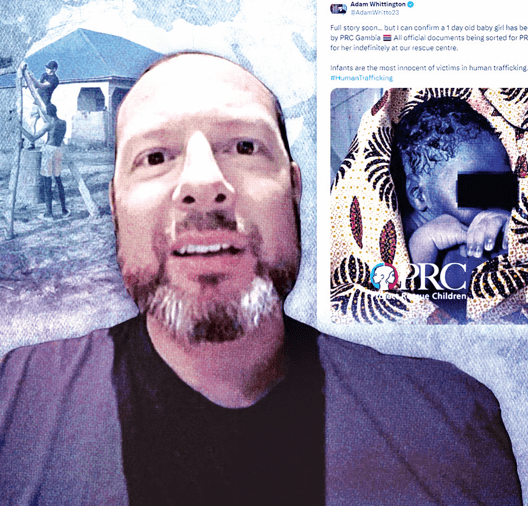
An ex-police officer who claims to save children from human traffickers has faked stories to raise money for his charity, the BBC has discovered.
Adam Whittington, founder of Project Rescue Children (PRC) says he has helped more than 700 children in countries including Uganda, Kenya and The Gambia.
But BBC File on 4 has found that some of these children have never been trafficked, and that funds raised – sometimes with the help of celebrity supporters – have not always reached children in need.
PRC has described our allegations that it does not support children as being “completely without merit, misleading and defamatory”.
Our investigation shows Whittington, a British-Australian citizen, has misled donors in a variety of ways – including by raising funds for a baby supposedly rescued from people traffickers, who has actually been with her mother all along. The mother, who lives in poverty, says she and her daughter have never received any money from PRC.
Whittington started working in child rescue two decades ago, after leaving the Metropolitan Police.
Custody disputes
He set up a company retrieving children taken abroad by a parent following custody disputes, but later switched his attention to trafficked or abused children.
Both his and PRC’s social media pages have accumulated 1.5 million followers and attracted celebrity support, thanks to their shocking and sometimes disturbing content.
Sam Faiers from ITV’s The Only Way is Essex became a PRC ambassador, and last September was taken to Uganda to meet orphaned and destitute children.
While there, she appealed to her millions of fans to donate and ended up raising £137,000 ($175,000) to build a rescue centre and cover its initial running costs.
It was this fundraising drive that gave me the first real sense that something was amiss.
In the weeks after Sam Faiers’ total was announced, allegations against PRC began popping up on social media, with former ambassadors and directors alleging financial mismanagement and suggesting stories about children were being fabricated
.
Less than half of the money – £58,000 ($74,000) – that donors believed would fund the construction and running costs of the proposed rescue centre, was sent to PRC’s Ugandan partner organisation, Make a Child Smile.
Its founder, Alexander Ssembatya, who has apologised to donors, told the BBC he believed the rest of the money had been “eaten by Adam Whittington and PRC”. Construction work was on hold because of a lack of funds, he added.
Sam Faiers told the BBC she was “deeply appalled” and “heartbroken” to learn that not all the funds raised had reached the children and urged Whittington to “do the right thing and release the remainder of the funds immediately to where they are so desperately needed”.
PRC said the money provided was sufficient to complete construction of the rescue centre, and told the BBC it had now withdrawn from the project, accusing Mr Ssembatya of refusing to sign a contract and mismanaging funds.
It said the remaining money had been spent on other children in Uganda and the Philippines.
Although efforts to establish a rescue centre in Uganda fell flat, PRC already claimed to have operations up and running in other African countries, including Kenya.
Since 2020, Whittington has told detailed and distressing stories about the children he has allegedly supported at PRC’s Kenya rescue centre – including siblings who had watched their parents being butchered by traffickers.
Within weeks of launching a sponsorship programme, PRC announced that all 26 Kenyan children pictured on its website had been sponsored.
Verifying existence
The rescue centre is in a remote location on the outskirts of the city of Kisumu, which made verifying its existence difficult.
So in April 2024, I travelled with a BBC team, escorted by a police officer, and found the property – supposedly run by a woman known as Mama Jane.
I discovered Mama Jane was an elderly lady called Jane Gori, who lived in the house with her husband. We didn’t find any children, rescued or otherwise.
But I did find out that her son, Kupa Gori, was PRC’s director in Kenya and he had brought Whittington to visit her home.
Whittington uses pictures of improvement work PRC has funded at Mrs Gori’s house to convince donors he is running a rescue centre. Mrs Gori said she had no idea that her name, her house and her photograph were being used by PRC.
Nearby, I met a farmer called Joseph, whose two sons and a granddaughter have featured on the PRC website, described as orphaned, homeless, or victims of trafficking or exploitation. But none of this is true.
Not long after the photographs were taken in 2020, Joseph’s son Eugene died. But his picture remained online until at least February this year. According to PRC’s website, people continued to sponsor him.
Joseph says he has never received any money from PRC, adding: “It pains my heart that someone is using the photos of my child for money we did not get personally.”
When we put our findings to PRC, it told us that it stands by its claim that Jane Gori’s home is a PRC rescue centre that cares for children. It said that all funds for work carried out there were submitted to the Australian Charity Commission – where it was registered.
It did not respond to our question about the misuse of photographs of Joseph’s family.
The next case of deception I uncovered started in 2022, when Whittington claimed to have carried out a dramatic rescue mission – saving a newborn baby from the clutches of traffickers in a busy marketplace in The Gambia.
On the morning of 17 December, his team chased two men who dropped a basket as they ran, he said. Inside was a newborn baby, whom he named Mireya. Whittington posted a picture of her wrapped in a gold-coloured blanket.
To give the story further credibility he told his followers he had adopted the baby and said she was being looked after at PRC’s rescue centre in The Gambia.
He told his UK director Alex Betts the same story and asked her to adopt the child with him.
Ms Betts, an online influencer, hoped to bring the baby back to the UK. An online fundraising campaign was launched, along with a sponsorship programme.
In March 2023, Ms Betts visited the girl she thought was Mireya and took photos and videos of herself playing with a beautiful baby girl. The footage went viral – seen by more than 40 million people.
After Ms Betts arrived back in the UK, Mr Whittington asked her to sign a non-disclosure agreement that would have prevented her saying anything publicly about PRC. She did not understand why and raised concerns.
Then PRC terminated her contract on the grounds, it said, that she was “exploiting children for social media gain”. Ms Betts stopped receiving photo and video updates about Mireya and Mr Whittington attacked her online, falsely branding her a drug addict and alleging, again falsely, that a warrant had been issued for her arrest in The Gambia.
Ms Betts says she was recruited to PRC to “bring social media attention to the organisation”. She rejects the claims against her and says she has always acted “with honest and pure intentions”.
When Ms Betts decided to google “Gambia newborn baby” she discovered the photograph of the baby in a gold blanket was of another child. It had been posted on a maternity unit’s social media page two years before Mireya’s “rescue”.
PRC told us a member of staff had misguidedly used this image because they didn’t want to reveal Mireya’s identity, and that the PRC board had subsequently apologised publicly for any confusion.
The BBC has found no evidence that the marketplace rescue ever happened. But Ms Betts had met a baby – so who was the child? In May 2024, a year after Ms Betts had posted her viral video, we travelled to The Gambia. Our first stop was the location of PRC’s supposed rescue centre.
But, just as we had found in Kenya, it was not a rescue centre and no rescued children had ever lived there. The man who owned the property told us it was just a family home.
Author
Latest News

Advertisement
More on News