Advertisement
How acacia trees are powering climate resilience in arid areas
Saturday 26th July, 2025 12:40 AM|

In the heart of Kenya’s arid north, where the soil cracks under a relentless sun and livelihoods are tested by heat and hunger, an ancient tree is quietly rewriting the survival story.
They call it “the tree of strength” and for good reason. Acacia, Africa’s indigenous and largely underexploited wonder tree, is emerging not just as a healer in traditional medicine, but also as a climate champion, an economic engine, and a symbol of resilience for communities battling the harsh realities of environmental change.
Among the Samburu, Rendille, and Maasai communities, acacia is more than just a tree—it’s sacred.
For centuries, its bark has been harvested and transformed into a potent traditional remedy, known in whispered circles as a natural aphrodisiac.
You Might Also Like
“We use it for strength, vitality,” says Mzee Wilfred Olengele, chair of the Merille Gums and Resins Aggregation Centre in Marsabit.
“Just soak the bark powder in water until it turns green, drink it, and you’ll know its power.”
Some mix the extract with bone marrow soup, creating a holistic elixir revered by generations.
But beyond its fabled uses, acacia trees serve as vital sources of livestock feed, wood, shade, and traditional medicines, forming the living heart of dryland survival.
For 39-year-old Syadho Mikiwa, acacia’s gift isn’t found in myths, it’s in her bank account. The mother of five has spent seven years harvesting gum Arabic from Acacia Senegal, collecting up to 300 kg monthly and earning about Ksh20,000 (USD 155).
It’s enough to feed, clothe, and school her children—and reclaim her economic independence.
“I don’t wait on my husband anymore. This is my work now,” she says, adjusting the sack of hardened resin crystals she’s just offloaded.
Mikiwa is one of 463 members in her local cooperative. Through community savings groups, she occasionally earns as much as Ksh50,000 during her table banking rounds.
For women and youth in Merille and beyond, gum and resin tapping has become more than seasonal work—it’s a dignified livelihood.
During dry months, the cooperative sells up to five tons of gums and resins. Still, experts argue this is just a fraction of the potential.
According to Abdi Somo, founder of East African Investment Holdings and a veteran in the gums and resins trade, the industry remains painfully underexploited.
“There’s demand for over 22 tons of gum Arabic from a single county every month,” he says.
“But Marsabit can only manage between 5 and 10. Only Samburu comes close to meeting that need.”
In stark contrast, Sudan dominates the global market, supplying over 80 per cent of the world’s raw gums.
Kenya, despite vast potential, lags due to weak infrastructure, lack of processing hubs, and poor market organisation.
International players like GIZ, FAO, WFP, and KEFRI have stepped in to change that. Through the Acacia Operation Project, started between 2004 and 2006, over 20,000 community members in eight northern counties now earn income from the trade.
“This is about more than economics,” says Meshack Muga, ASAL Restoration Initiative Program Coordinator at FAO.
“Acacia represents sustainable farming, desert restoration, and local empowerment.”
Acacia trees aren’t just economic assets—they’re ecological sentinels. With deep roots that tap underground water and stabilise soil, acacias slow desertification, restore degraded lands, and support biodiversity.
“Acacia fixes nitrogen into the soil. It regenerates fertility naturally,” explains Joseph Ilkul of the World Food Programme. “It’s not just surviving the climate crisis. It’s fighting back.”
In Marsabit, County CEC for Environment Grace Galmo says acacia may be the region’s best hope against climate shocks. But she laments a critical lack of investment.
“We don’t have enough aggregation parks, awareness programs, or policy frameworks,” she notes. “We must treat this as the green gold of the drylands simply because that’s what it is.”
Science now confirms what indigenous communities have long known. Acacia species are rich in bioactive compounds like flavonoids, tannins, and saponins, natural chemicals with anti-inflammatory, antioxidant, antimicrobial, and even anti-cancer properties.
Gum Arabic, a natural exudate from Acacia Senegal, is used globally as a thickener and stabiliser in soft drinks, syrups, and food or as an emulsifying agent in pharmaceuticals and cosmetics and binding agent in adhesives, paints, and printing inks
Health-wise, it’s a dietary fibre that improves digestion, lowers blood glucose, and supports gut health. Some studies suggest it may help prevent colon cancer and support liver detox pathways.
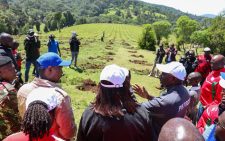
Across Laisamis and other parts of Northern Kenya, communities are turning to Farmer Managed Natural Regeneration (FMNR) to revive lost acacia forests.
The approach, championed by World Vision, promotes the regrowth of indigenous trees from natural stumps and seeds.
Through FMNR, acacia species like Acacia Nubica and Acacia Senegal are being restored, offering shade, fodder, medicine, and hope to a region once written off as barren.
“Acacia is not just a tree,” says Galmo. “It’s a teacher, a healer, a barrier to desert, and a bridge to a more resilient future.”
Despite its promise, Kenya’s acacia value chain remains a sleeping giant. Experts urge the government, private sector, and NGOs to invest in modern tapping techniques and equipment, Aggregation and value addition centres, market linkages and export facilitation and Policy frameworks for sustainable harvesting
“The future of drylands lies in smart restoration—not abandonment,” says GIZ’s Ahmoud Maya. “If we nurture acacia, it will nurture our people back.”
In the fight against poverty, land degradation, and climate breakdown, the acacia tree may well be Northern Kenya’s most powerful ally.
It holds no speeches, seeks no spotlight, but in its quiet way, it heals, feeds, shields, and sustains.
It is, indeed, the green gold of the drylands.
Author
Jacob Walter
View all posts by Jacob WalterLatest News







Advertisement
More on News