Advertisement
Green Belt Movement condemns Senate passage of forest law amendment
Thursday 14th May, 2026 10:37 PM|

The Green Belt Movement has condemned the Senate’s passage of the Forest Conservation and Management (Amendment) Bill, 2025, raising concerns over proposed changes to Section 56(2) of the Forest Conservation and Management Act, 2016.
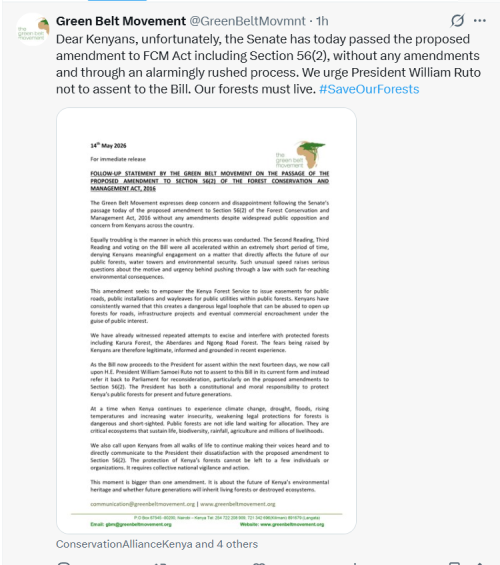
In a statement released on Thursday, May 14, 2026, the organisation expressed “deep concern and disappointment” over the Senate’s approval of the Bill.
The Green Belt Movement criticised the speed at which the Second Reading, Third Reading, and voting were conducted, stating that the process limited public engagement on a matter affecting public forests, water towers, and environmental security.
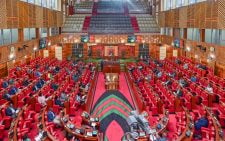
This comes shortly after the Senate passed the Bill after voting results were announced as unanimous. Deputy Speaker Kathuri Murungi declared: “The Ayes are 31, the Nays are zero, and abstentions are zero. The Ayes have it.” The Bill, National Assembly Bills No. 38 of 2025, now proceeds to the President for assent within 14 days.
Call for presidential review and public engagement
You Might Also Like



The Green Belt Movement has called on President William Samoei Ruto not to assent to the Bill in its current form and instead refer it back to Parliament for reconsideration. The organisation stated that the President has both a constitutional and moral responsibility to safeguard public forests for present and future generations.
The statement further called for continued public engagement on the matter, urging Kenyans to communicate their concerns regarding the amendment. It said the decision process would have long-term implications for environmental conservation and national ecosystems, particularly in relation to forest protection and sustainability.
Concerns over forest access provisions
The amendment proposes to empower the Kenya Forest Service to issue easements for public roads, public installations, and wayleaves for public utilities within protected forests. The Green Belt Movement stated that the provision creates a legal framework that could be misused to open up protected forests for infrastructure development under the justification of public interest.
The organisation referenced past attempts to interfere with forests including Karura Forest, Aberdares, and Ngong Road Forest, stating that public concerns over forest protection are grounded in previous experiences.
The statement said the amendment could affect Kenya’s forest conservation framework at a time when the country is facing climate change impacts, droughts, floods, rising temperatures, and water insecurity.
Author
Latest News





Advertisement
More on News