Advertisement
Govt signals end to automatic rescue for Kenyan citizens in unstable countries
Tuesday 23rd December, 2025 07:14 AM|

Kenyans choosing to work or travel to unstable countries may no longer count on automatic government rescue, following a proposed policy shift.
In its press statement on Monday, December 22, 2025, the Ministry of Foreign Affairs directed families of the remaining Kenyans pending repatriation in foreign countries to procure return tickets independently and not depend on the government for that.
“86 Kenyans in military shelters initially refused cooperation, demanding government-funded tickets and spreading falsehoods on social media, but shared next-of-kin details on December 19, 2025,” the ministry wrote on Facebook.
The government has said that the blanket assistance strains resources and erodes accountability, threatening to change the way it operates while responding to distressed Kenyans.
You Might Also Like



The government also announced the repatriation of 119 Kenyans who had been successfully repatriated from Myanmar following recent raids by Myanmar authorities and rebel groups.
This follows an operation where Myanmar security officials raided the swindling compounds. The operators of the camps fled, abandoning workers, including over 200 Kenyans who sought refuge in military shelters in Myawaddy and Shwe Kokko, while another group of over 100 Kenyans crossed over to Thailand.
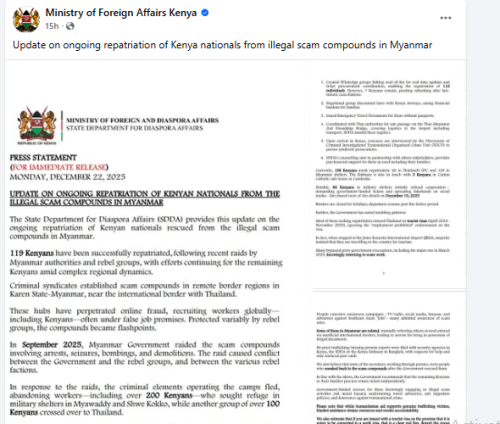
The ministry has announced that 198 Kenyans await repatriation; this includes 66 in Thailand’s IDC and 129 in Myanmar shelters. The Embassy is also in touch with 3 Kenyans in the Caritas Catholic safe house in Cambodia.
The ministry also revealed that most of those seeking repatriation entered Thailand on tourist visas between April 2024 and November 2025, ignoring the “employment prohibited” endorsement on the visa.
According to the ministry, investigations at JKIA found many Kenyans travelling abroad claim to be tourists, while others who skipped past evacuations knowingly returned to illegal work overseas.
“Government-funded rescues for those knowingly engaging in unlawful swindling activities risk moral hazard, undermining travel advisories, safe migration policies, and deterrence against transnational crime,” the statement read.
The ministry further warned that government-funded rescue missions for individuals who knowingly engage in unlawful activities risk moral hazard for the country.
Upon arrival in Kenya, the repatriated Kenyans are interviewed by the Directorate of Criminal Investigations (DCI) Transnational Organised Crime Unit (TOCU) to pursue syndicate prosecutions.

Fraudulent jobs
This comes days after Prime Cabinet Secretary Musalia Mudavadi raised an alarm over the risk of Kenyans being rescued from cyber scam networks abroad, bringing the vice back home.
In a press briefing on Quarterly Status of Foreign Affairs on Wednesday, November 12, 2025, Mudavadi revealed that intelligence reports had shown that some Kenyans lured to Southeast Asia for fake job offers later became complicit in organised scams.
“It is a sophisticated menace where our citizens, often lured by fraudulent job advertisements and agents purportedly in places like Thailand, are trafficked to South East Asia for exploitation, including forced labour, online scamming, illegal cryptocurrency trade, and even organ harvesting,” he stated.
Mudavadi cited the case of a Kenyan man who was arrested again in Thailand for entering the country using fake documents, despite having been successfully repatriated by the Kenyan government previously.
“This shows that some of the victims are not innocent and are part of the criminal network. A major concern is that rescued individuals pose a national threat by potentially establishing scam operations in Kenya upon their return. Recommendations that we make focus on a nationwide awareness campaign, strengthening legal frameworks, and enhancing victim support and integration,” Mudavadi added.
Author
Latest News








Advertisement
More on News