Advertisement
Government to construct 50 new hospitals
Thursday 21st October, 2021 12:00 AM|
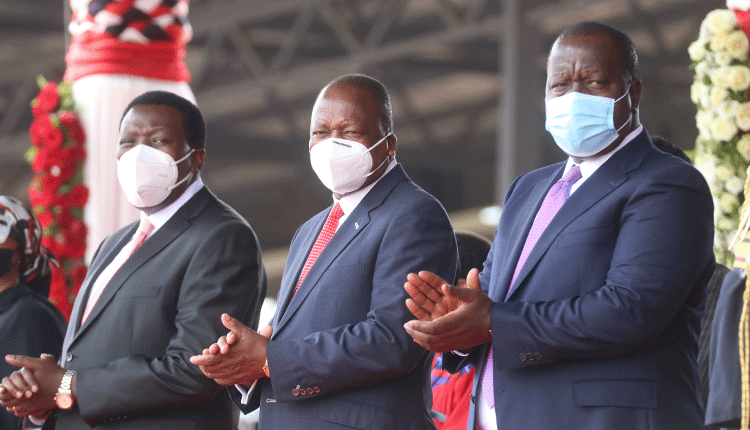
The government will construct 50 new hospitals to enhance access to medical cover, President Uhuru Kenyatta announced yesterday.
New Level 3 facilities to be situated in non-covered regions and densely populated areas across in the 47 counties will cost Sh3.2 billion.
“In order to enhance access to medical coverage and as part of our Universal Health Coverage programme, I direct the Ministry of Health to establish an additional 50 new Level 3 hospitals.
I further direct the National Treasury to allocate Sh3.2 billion for immediate construction of these medical facilities,” the Head of State announced during his Mashujaa Day speech at Wang’uru stadium, Kirinyaga county.
He also stated that the government has put in place a comprehensive nationwide programme to upgrade selected hospitals in all the counties through provision of specialised, modern, state-of-the-art medical, diagnostic and critical care equipment.
“Through the Managed Equipment Services (MES) project, whose objective is to improve access to quality specialised healthcare services throughout the country, and which is fully funded by my government, we identified and equipped 115 hospitals with various theatre equipment, 101 hospitals with various radiological and imaging equipment, 14 facilities with ICU equipment and 54 facilities installed and commissioned renal equipment including dialysis machines,” he said.
Under this massive investment, 628,821 people have benefitted from theatre services, 385,587 people benefited from dialysis out of the 577 dialysis machines installed, 23,574 people benefited from ICU services and over 5.7 million people have been served using the 22 MRI machines, 214 X-ray machines, 83 CT scanners and 229 ultra-sound equipment since 2016. All these sum investments have benefitted over six million patients and saved the country a total Sh131.5 billion.
Noting that the transformation of the health sector is probably one of the most phenomenal testimonies of how the country transformed Covid-19 obstacles into opportunities that expanded health facilities, President Kenyatta said in Nairobi alone, the government constructed and operationalised 15 level 2 and 3 hospitals in various informal settlements, through the Nairobi Metropolitan Services another 15 are under construction.
“One of the unintended benefits of the pandemic is that we have increased our ICU capacity by an impressive 502 per cent from 108 to 651 ICU ready beds.
Similarly, our total hospital bed capacity as a country has increased by 47 per cent from 56,069 in 2013 to the current figure of 82,291 hospital beds spread throughout the country,” he added.
Reference laboratories
During the Covid-19 pandemic period, he stated, the country improved its oxygen generation capacity in public health facilities from 3 million litres per day in March 2020, to 32 million litres per day in October 2021.
“We have further increased the number of reference laboratories that can test for notifiable diseases of international concern and public health importance, from one single laboratory in March 2020 at the beginning of the pandemic to the current 95.
“Let me remind you that at the beginning of the pandemic early last year, we used to ship our samples for testing in South Africa and the results turnaround time would be anything from five days onwards,” said the President.
These strategic diagnostic investments, he observed, have strengthened the country’s health care system especially in response to the Covid-19 pandemic; and will propel the country faster towards attainment of UHC and fortify its preparedness for future global health security challenges.
Health workforce
“The health workforce is a key pillar of every healthcare system. Yet, many a times, it turns out to be the weakest link typically seen as a cost driver instead of an area for public and private investment in health service provision,” said the head of State.
In a bid to bridge the gap in human resources for health, he disclosed that the government has progressively recruited an additional 36,900 healthcare workers in the last 9 years, nearly a 100 per cent increment in the country’s total public health workforce which currently stands at nearly 75,000 workers.
“The mid-level healthcare workers play a critical role in health service delivery throughout all the levels of care and specifically at the primary care level.
To this end, we have expanded the capacity of our Medical Training Colleges to train this critical mass of health experts from 28 KMTC campuses in 2013 to the current 71 campuses spread across 44 of our 47 counties,” he said.
Author
Oliver Musembi
View all posts by Oliver MusembiLatest News



Advertisement
More on News