FAO report reveals 2 in 3 Africans cannot afford healthy food
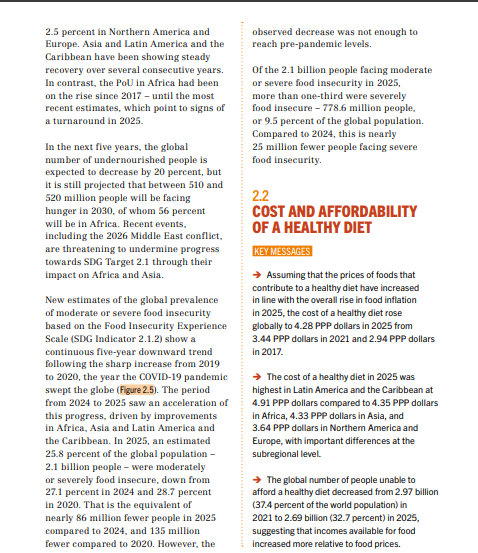
By Aloys Michael, July 23, 2026Two out of every three Africans still cannot afford a healthy diet despite easing inflation across many countries, raising fresh concerns over food affordability in Kenya and across the East African Community (EAC).
The latest State of Food Security and Nutrition in the World 2026 report by the Food and Agriculture Organization (FAO), International Fund for Agricultural Development (IFAD), UNICEF, World Food Programme (WFP) and World Health Organization (WHO) estimates that 66.6 percent of Africans were unable to afford a healthy diet in 2025, compared with 28.9 percent in Asia, highlighting Africa’s widening nutrition gap.
The report comes as Kenya’s food prices remain elevated for many nutritious foods despite headline inflation easing from the highs witnessed during the 2022–2023 food crisis. While staple foods have become relatively more affordable, millions of Kenyan households continue to struggle with the cost of healthy food in Kenya, particularly fruits, vegetables, milk, eggs and animal-source proteins.
The FAO warns that “healthy diets are essential to achieving Sustainable Development Goal 2, but remain economically out of reach for large segments of the global population.” It adds that reducing the cost of nutritious foods is “a necessary, though not sufficient, condition to enhance diet quality and thus improve nutrition, health and development outcomes.”
For many families, the challenge is no longer finding enough food but affording foods that provide balanced nutrition. A household may still put ugali or rice on the table, yet regularly purchasing milk, eggs, beef, fish, fruits and traditional vegetables such as sukuma wiki, spinach and managu remains difficult. This explains why a healthy diet in Kenya continues to be a growing policy concern despite improving macroeconomic indicators.
Why prices remain high
The FAO food report 2026 suggests the problem extends well beyond inflation.
According to the report, animal-source foods, fruits and vegetables account for nearly 70 per cent of the total cost of a healthy diet, while starchy staples contribute only about one-sixth of the total cost despite providing around half of the calories required in a healthy diet.
In practical terms, this means households can often afford enough calories but not enough nutrients. As incomes come under pressure, consumers are more likely to prioritise cheaper staples over nutrient-rich foods, increasing the risk of poor nutrition.
The report also identifies food supply chains as a major contributor to rising costs. It notes that post-farmgate activities account for between 70 and 75 per cent of what consumers ultimately pay for food, with processing, logistics, transport and wholesale distribution making up a significant share of retail prices.
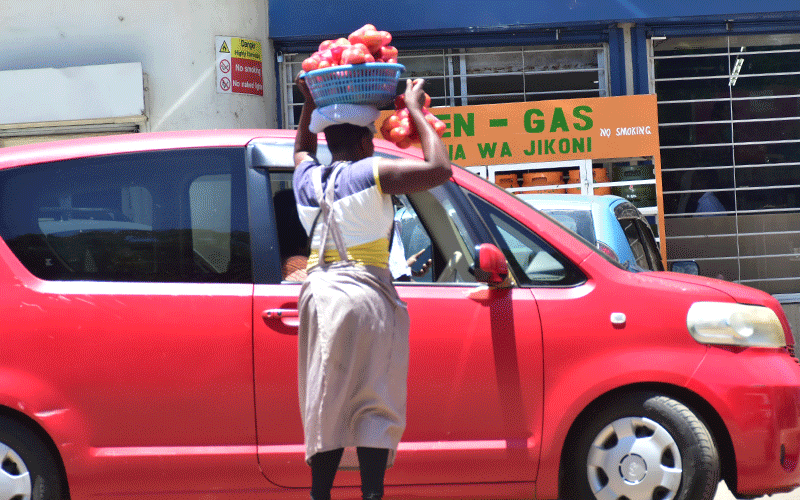
Those findings mirror Kenya’s long-standing challenges. High transport costs, post-harvest losses, limited cold storage facilities and fragmented agricultural markets continue to push up the prices of fruits, vegetables and other perishable foods in Nairobi and other urban centres.
Regional picture
The affordability challenge is shared across the East African Community, although countries experience it differently. Uganda’s relatively strong agricultural production has helped keep prices of several fresh foods competitive, while Tanzania has benefited from stable harvests in recent seasons. Kenya, however, remains more exposed to climate shocks, higher logistics costs and supply disruptions that increase retail prices for nutritious foods.
The report says differences in the cost of healthy diets are influenced not only by food prices but also by agricultural productivity, efficient transport systems, lower input costs and stronger regional trade integration. It notes that higher agricultural productivity, sustained public investment in agricultural research and development, efficient logistics and transport, effective trade integration, and lower input costs are each associated with a lower cost of a healthy diet.
Rather than relying solely on subsidies, the report argues that governments should invest in irrigation, agricultural research, rural roads, cold-chain infrastructure and regional trade to improve access to affordable food in Kenya and the wider region.
The report also reveals the scale of Africa’s food insecurity challenge. Although global hunger declined to 7.8 per cent of the world’s population in 2025, Africa is now home to 309 million hungry people, surpassing Asia for the first time. Without faster progress, 56 per cent of the world’s hungry population could be living in Africa by 2030.
For Kenya, the message from the FAO food report 2026 is clear. Producing enough food is only part of the solution. The bigger challenge is ensuring that ordinary households can afford nutritious diets every day.
Unless the prices of milk, eggs, fruits, vegetables and other nutrient-rich foods become more affordable, easing Kenya food inflation alone will not deliver healthier diets or better nutrition outcomes for millions of families.