Faith Odhiambo: SHA algorithm overcharges the poor while undercharging the wealthy
By Mustafa Juma, May 9, 2026Former Law Society of Kenya (LSK) President Faith Odhiambo has sharply criticised Kenya’s Social Health Authority (SHA) system, accusing its AI-driven model of unfairly burdening low-income earners while benefiting wealthier citizens.
Taking to her official X account on Saturday, May 9, 2026, Odhiambo described the system as a form of “digital poverty extraction”, arguing that it is worsening inequality in access to healthcare financing rather than solving it.
She faulted the design of the SHA contribution model, saying it fails to capture the lived realities of vulnerable Kenyans, particularly low-income mothers and informal workers.
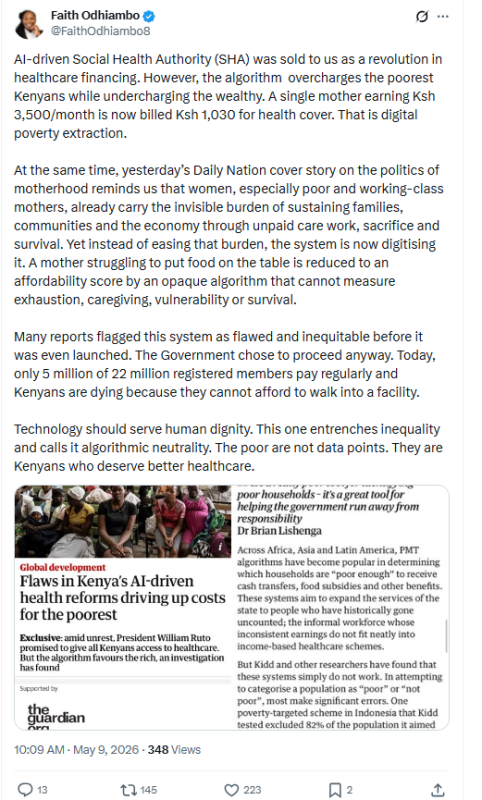
“AI-driven Social Health Authority (SHA) was sold to us as a revolution in healthcare financing. However, the algorithm overcharges the poorest Kenyans while undercharging the wealthy. A single mother earning Ksh 3,500/month is now billed Ksh 1,030 for health cover. That is digital poverty extraction,” Odhiambo stated.
She further argued that the system assumes income is the only measure of ability to pay, ignoring caregiving responsibilities, unemployment gaps, and other social pressures.
“A mother struggling to put food on the table is reduced to an affordability score by an opaque algorithm that cannot measure exhaustion, caregiving, vulnerability or survival,” she stated.
Concerns over AI-driven healthcare financing
Odhiambo also questioned the use of artificial intelligence in determining healthcare contributions, saying the algorithm appears opaque and lacks adequate public accountability.
She warned that while technology is often presented as neutral, it can reinforce existing inequalities when designed without strong social safeguards.
“Technology should serve human dignity. This one entrenches inequality and calls it algorithmic neutrality. The poor are not data points. They are Kenyans who deserve better healthcare,” she wrote on X.
Public concern over SHA rollout
The comments come amid ongoing public debate about the implementation of the Social Health Authority system, which replaced the National Health Insurance Fund (NHIF).
Critics have raised concerns about affordability, access to healthcare services, and system transparency, particularly for informal sector workers and low-income households.
Reports of individuals being unable to access medical services due to unpaid contributions have further intensified scrutiny of the system’s rollout.
SHA charges
SHA was recently forced to clarify how it calculates health insurance contributions after an investigative report by Africa Uncensored questioned the system used to determine the varying amounts paid by households.
The investigation focused on the Means Testing Instrument (MTI), an AI-powered tool used by SHA to assess how much each household contributes monthly to the Social Health Insurance Fund (SHIF).
According to the report, the contribution amounts differ significantly among households, prompting concerns over the transparency and accuracy of the system.
“The Social Health Authority (SHA) notes the concerns raised by Africa Uncensored regarding the Means Testing Instrument (MTI) utilised to determine Social Health Insurance Fund (SHIF) contributions,” SHA stated in an X statement on Wednesday, May 6, 2026.
The MTI tool is based on Proxy Means Testing (PMT), which assesses contributions for households in the informal sector.
According to SHA, under the old system, NHIF charged Ksh500 for someone earning Ksh10,000, which is 5 per cent of their income, while someone earning Ksh1 million paid only Ksh1,700, just 0.17 per cent.
Using this illustration, SHA maintained that the previous NHIF contribution model unfairly penalised low-income earners.