Advertisement
SHA responds to Africa Uncensored exposé over varying charges and salary deductions
Thursday 07th May, 2026 07:38 AM|

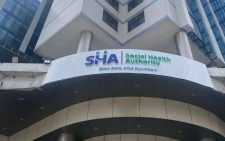
The Social Health Authority (SHA) has clarified how it calculates health insurance contributions after an investigative report by Africa Uncensored questioned the system used to determine the varying amounts paid by households.
The investigation focused on the Means Testing Instrument (MTI), an AI-powered tool used by SHA to assess how much each household contributes monthly to the Social Health Insurance Fund (SHIF).
According to the report, the contribution amounts differ significantly among households, prompting concerns over the transparency and accuracy of the system.
“The Social Health Authority (SHA) notes the concerns raised by Africa Uncensored regarding the Means Testing Instrument (MTI) utilised to determine Social Health Insurance Fund (SHIF) contributions,” SHA stated in an X statement on Wednesday, May 6, 2026.
You Might Also Like

The MTI tool is based on Proxy Means Testing (PMT), which assesses contributions for households in the informal sector.
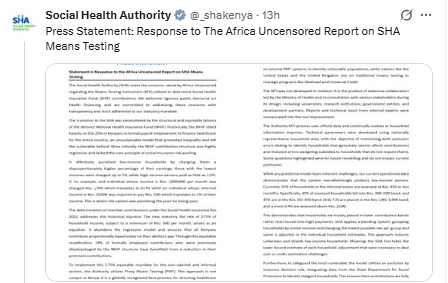
To make its case, SHA pointed to the previous system, the National Health Insurance Fund (NHIF), highlighting how unfair it was, especially to burdened low-income households, while letting high earners off far too lightly for years.
According to SHA, under the old system, NHIF charged Ksh500 for someone earning Ksh10,000, which is 5 per cent of their income, while someone earning Ksh1 million paid only Ksh1,700, just 0.17 per cent.
Using this illustration, SHA maintained that the previous NHIF contribution model unfairly penalised low-income earners.
“This is where the system was punishing the poor for being poor,” it said.
Under the new SHA healthcare contribution framework, households now pay a flat rate of 2.75 per cent of their income, with a minimum monthly contribution of Ksh300.
According to the health scheme, 54 per cent of formally employed Kenyans are paying less compared to the former NHIF system.
However, investigations by Africa Uncensored revealed concerns over algorithmic bias in the AI-powered assessment model, claiming that it overcharges many low-income households while underestimating the earnings of wealthier individuals.
The investigation further highlighted a major challenge facing the government: the lack of accurate income data for most Kenyans, raising concerns about the reliability of AI-driven healthcare financing systems.
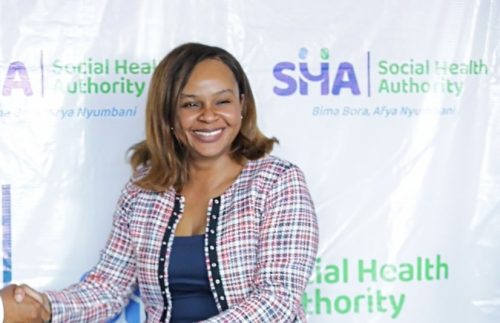
Concerns over SHA
The investigation also casts doubt on the accuracy of the government’s means-testing formulas under SHA, claiming error rates of between 80 and 90 per cent in determining poverty levels.
According to Africa Uncensored, this would mean that 80-90 per cent of the people will be overcharged under the proxy assessment tool currently being used.
In response to the claims, SHA maintains that the MTI was developed through a collaborative process involving universities, research institutions, government agencies, and development partners, making significant inaccuracies unlikely.
The authority further argues that its operational data indicates the tool is benefiting low-income earners. SHA says that 92 per cent of informal sector households assessed through the MTI are assigned monthly contributions of Ksh850 or less.
Of this group, 45 per cent fall within the Ksh300–500 contribution bracket, while another 47 per cent are placed in the Ksh501–850 category.
The investigation also questioned approximately Ksh10.6 billion in suspicious claims, including payments reported to have been made to ghost hospitals for services that were never provided, claims that SHA strongly denies.
Author
Latest News




Advertisement
More on News