Advertisement
‘Time to ask whether Ruto’s bottom-up agenda has made our lives better or bitter’ – Eugene Wamalwa
Saturday 10th August, 2024 10:23 AM|

Democratic Action Party of Kenya (DAP-K) leader Eugene Wamalwa has called for the review of the Bottom-up Transformation Agenda (BETA) which catapulted President William Ruto to power.
In a statement on Saturday, August 10, 2024, the former Defence CS indicated that after three years of implementing the Bottom-up model, Kenyans are now validated to ask questions about whether it has lived up to its expectations or it has failed.
After deep introspection and evaluation of the model which majorly targeted the low class referred to as Hustlers at the height of the 2022 presidential campaigns, Wamalwa further added it is time for Kenyans to decide whether Ruto and his Deputy President Rigathi Gachagua deserve a second chance.

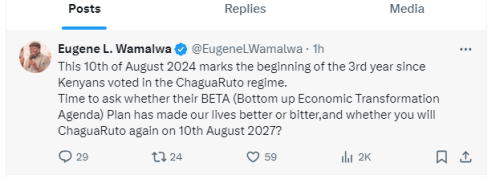
“This 10th of August 2024 marks the beginning of the 3rd year since Kenyans voted in the ChaguaRuto regime.
“Time to ask whether their BETA (Bottom up Economic Transformation Agenda) Plan has made our lives better or bitter and whether you will ChaguaRuto again on 10th August 2027,” Eugene Wamalwa wrote.
Ruto’s Bottom-up idea
According to President Ruto’s administration, BETA is the government’s transformation agenda geared towards economic turnaround through a value chain approach.
BETA was touted to target sectors with the highest impact to drive economic recovery and growth. This was to be achieved by bringing down the cost of living; eradicating hunger; creating jobs; expanding the tax base; improving foreign exchange balances; and inclusive growth.
Further, the Bottom-up model was expected to ensure rational resource allocation by eliminating wastage of resources occasioned by duplication, overlaps, fragmentation and ineffective coordination in the implementation of programmes and projects.
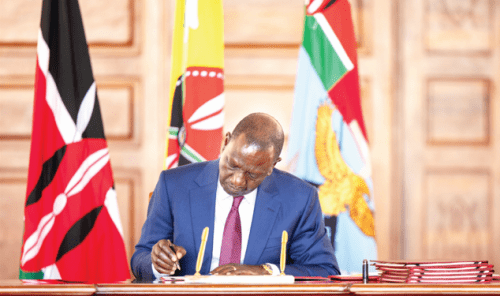
“The government aims to transform agriculture by raising the productivity of key value chains that include leather and leather products, textile and apparel, dairy, tea, rice, edible oils, the blue economy, minerals including forestry, and construction/building materials,” the Kenya Kwanza stated during the launch of The Fourth Medium Term Plan.
However, in his argument, Wamalwa insists that three years is enough for Kenyans to gauge the plan and see if it has made significant changes to the lives of Kenyans or if it is time for the citizens to start looking for an alternative ahead of the 2027 polls.
Wamalwa’s consistent opposition
Wamalwa has been one of the biggest critics of the Kenya Kwanza administration. He was among the Azimio leaders who refused to sign the National Dialogue Committee report for failing to address the costs of living.
Despite refusing to sign the report, Wamalwa has also been calling out the Kenya Kwanza administration due to their responses during the anti-government protests.
Recently, has ganged up with the Wiper Party leader Kalonzo Musyoka to reject calls for dialogue in a bid to end the protests.
For the avoidance of any doubt, we are not boarding. pic.twitter.com/hwFjHnp0LK
— Eugene L. Wamalwa (@EugeneLWamalwa) July 19, 2024
Author
Lutta Njomo
View all posts by Lutta NjomoLatest News








Advertisement
More on News