Advertisement
DCI flags reputational risks linked to Kenya’s grey listing status
Saturday 25th April, 2026 10:16 AM|

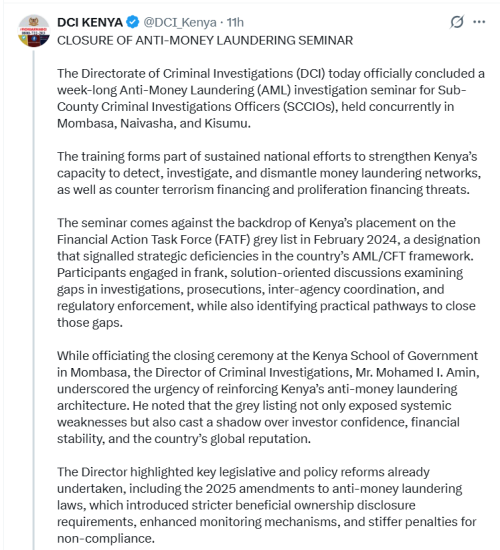
The Directorate of Criminal Investigations (DCI) has intensified its focus on financial crime enforcement, highlighting risks associated with Kenya’s continued inclusion on the Financial Action Task Force (FATF) grey list.
The remarks were made during the closing of a week-long Anti-Money Laundering (AML) seminar held at the Kenya School of Government in Mombasa on April 24, 2026.
While officiating the event, DCI Director Mohamed Amin underscored the urgency of reinforcing Kenya’s anti-money laundering architecture.
He stated that the grey listing, imposed in February 2024, exposed systemic weaknesses and continues to affect investor confidence, financial stability, and the country’s global reputation.
You Might Also Like



“Mohamed Amin underscored the urgency of reinforcing Kenya’s anti-money laundering architecture. He noted that the grey listing not only exposed systemic weaknesses but also cast a shadow over investor confidence, financial stability, and the country’s global reputation,” read the DCI X post in part.
Training programme across multiple regions
The AML seminar was conducted concurrently in Mombasa, Naivasha, and Kisumu for Sub-County Criminal Investigations Officers. The sessions focused on detection and investigation of money laundering, terrorism financing, and proliferation financing activities.
Participants reviewed gaps in investigations, prosecution processes, inter-agency coordination, and regulatory enforcement, and identified measures to address them.
In Naivasha, Director of the Investigations Bureau Francis Ndiema stated that grey listing contributes to reduced foreign investment, increased scrutiny of financial transactions, and a higher cost of doing business.
He called on officers to apply training outcomes in investigations. In Kisumu, Director of Inspection Isaack Mwenda Meme emphasised the importance of maintaining integrity and sharing acquired knowledge across operational units.
Reforms, enforcement capacity and regulatory changes
The training follows earlier sessions initiated in February 2026, with more than 500 officers trained in specialised financial investigations. The Financial Investigations Unit is also undergoing modernisation, including improved case management systems and alignment with international standards.
Kenya has implemented legal and policy reforms through the Anti-Money Laundering and Combating of Terrorism Financing Laws (Amendment) Act, 2025.
The changes introduced stricter beneficial ownership disclosure requirements, enhanced monitoring systems, strengthened Know-Your-Customer rules, and increased penalties for non-compliance.
The reforms form part of broader measures to address compliance gaps identified by FATF.
Kenya remains on the grey list alongside continued monitoring, while several African countries were delisted in October 2025 after completing required reforms. The listing has also contributed to additional compliance requirements in international financial transactions involving Kenya.
Author
Latest News







Advertisement
More on News