Advertisement
Why schooling should go beyond just routine
Wednesday 01st June, 2022 11:05 AM|
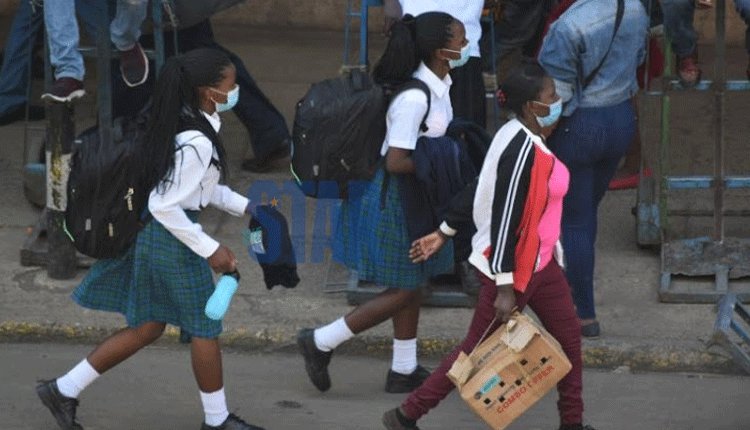
Children do not leave home to start schooling as empty slates. They carry with them knowledge that is context specific, particular to their families and the larger environment in which they have grown.
Therefore, the singular reason why families and communities decide on the schooling of their children, is to help them travel in space and time, to obtain learning that is not local and knowledge that is drawn beyond their local geographical ridges, social structures, political organisation and economic models.
This is not to discount and dismiss the intrinsic value of local knowledge as context pollinated and weaved, but such knowledge only serves as entry behaviour foundation stone, that is used as a lower rung on a ladder—you cannot get up the ladder without that step but it is not the penultimate rung on the ladder.
Looking at the catchment areas of our primary and secondary schools, you will notice that there are different colours on the catchment strands—school therefore becomes a place where each learner puts down that which they have learnt, know and practice as a stepping stone for the new—non local knowledge that is couched in generalised principles of education.
Michael Young; the proponent of the question What are schools for? argues that the primary function of a school should lie in assembling the necessary conditions, that facilitate the acquisition of this powerful knowledge that is non-local and drawn from contexts yonder.
The question we then need to ask ourselves under the Competency-Based Curriculum (CBC) reform process is; what have we done with the current Grade Six learners as we prepare them to transit to junior secondary next year?
We have seen them wear sacks and clean markets, we have asked their parents to help them print photographs of their kitchens and construct their basic family tree- is that enough to warrant transition to another level of schooling?
Schooling should not just be routine; it should inspire choice, dignity, critical thought far higher aspirations than the learners could acquire under the ‘loose’ learning arrangement at the household or community level, be they academic or otherwise. Our reform process was botched from day one when we refused to listen to teachers before embarking on the process.
Well trained and confident teachers need to serve the function of ‘town and village criers’ as Chinua Achebe would have put it. Reaching out not only to pass information but to consolidate knowledge from other disciplines, sequence it in domains and plan on when and how it should be delivered to the learners.
For us to rescue the teetering reform currently underway; we have to find a way of returning teachers to the epicentre. Teachers need to lead the reform dialogue with other professionals and disciplines and not receive instructions, epithets and commands in a matter they should be prosecuting themselves. The situation is both myopic and draconian.
If we keep the thread from Young on What are schools for? we then realise that we have not only brutalised the ‘conservative function of school’, but we have also disregarded the central role teachers play in curating, weighting, appropriating content and preserve knowledge.
The reform approach under the Jubilee regime to give us CBC out of Jogoo House, Kenya Institute of Curriculum Development and the invisible hands, has further compartimentalised learning and we are even being promised that the same approach shall obtain in Junior Secondary. We have lost the wholesomeness of teaching and learning.
The education and reform leadership keeps talking about jobs, skills, markets, from cockcrow to the time goats bleat and return to the shades at sun-set. None of these people have helped the parents, guardians and stakeholders appreciate how their stiff-necks, frailty of their approach sits with the fluidity and ruthlessness of the local and global market forces and related concepts.
Young must have been a fore seer when he concluded that the resolution of the political demands and the education realities remain a critical educational pursuit of our time if I were to paraphrase him slightly.
— The writer is a trained teacher and education policy expert
Author
PD columnist
View all posts by PD columnistLatest News




Advertisement
More on Insights