Advertisement
Senate should reject offer to help amend the supreme law
Friday 01st August, 2025 05:40 AM|
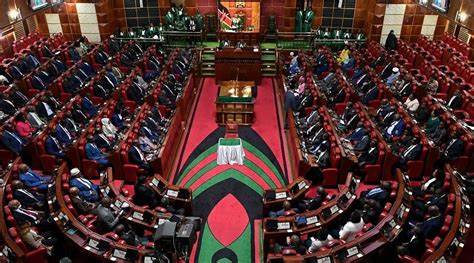
Despite its past demonstrable disdain for the Senate, the National Assembly now seeks its support to amend Article 204 of the Constitution to entrench three Funds. The Constitution of Kenya (Amendment) Bill 2025 seeks to validate the National Constituencies Fund, Senate Oversight Fund and National Government Affirmative Action Fund.
The bill’s promoters are two distinguished lawyers, including Rarieda MP Otiende Amolo, who chaired the Committee of Experts that superintended the constitution-making process leading to the promulgation of the 2010 charter.
Amolo understands the original conception of the Senate as the Upper House under the Bomas Draft, and its subsequent, politically motivated, emasculation by partisan interests at the infamous 2009 Naivasha parley at the height of the Orange Democratic Movement vs Party of National Unity rivalry.
To its credit, the Committee of Experts rescued the Senate from the comatose state the Constitution Implementation and Oversight Commission had consigned it. Despite the team’s rescue efforts, the Senate was deformed beyond recognition and rendered impotent with vague and fuzzy constitutional authority over devolution, specifically, and in the legislative architecture, generally.
You Might Also Like


The Senate has suffered immensely since, under the oppressive yoke of the National Assembly and Executive, often forced to run to the Supreme Court for advisories that are, routinely, ignored by the Speaker of the National Assembly.
The annual budget-making process, especially, the determination of shareable revenue, is a moment of pain and angst for the Senate. It is treated as a nuisance and whining child whose opinion is sought only to fulfil a constitutional requirement but ignored afterwards as the National Assembly proceeds to implement its predetermined fiat.
The Senate’s constitutional roles have also been usurped, through bullying, by the National Assembly and its Speakers, such as in treaty making per Article 71 of the Constitution and vetting of the electoral body. The Senate has also not been allowed to play its role in superintending control of the security organs, including the National Security Council in line with Articles 239 (6) and 240 (7) and (8)of the supreme law.
The framers of the 2010 charter allocated a clear constitutional role for the Senate, even in its depleted post-Naivasha fashion, in deployment of Kenyan police and military forces abroad and internally, which the National Assembly and Executive have yanked away.
The bullying by the National Assembly extends to the Judiciary. The assembly has refused to allocate money to the Judiciary Fund, a constitutional creature. Every fiscal year, the Judiciary’s budgetary requests are slashed by the National Assembly without just cause. The Senate is now expected to believe that this time around the assembly will budget for the so-called Senate Oversight Fund, faithfully, when it has failed the Judiciary without mercy.
With this in mind, the National Assembly does come to this attempt to further muddle the 2010 Constitution, with clean hands. The Senate must decline the invitation to participate in this travesty for several reasons, including that promoters of the bill have fostered the false hypothesis that it does not require a referendum to pass the proposed amendments.
The Senate Oversight Fund is a sweetener, clothed as good faith to hoodwink senators into rubber-stamping a bad law. There is no attempt, whatsoever, by Amolo and Samuel Chepkonga to expand the Senate’s constitutional authority to protect devolution.
If approved, the bill will entrench three funds to supplant and compete with gubernatorial authority. Fourth, the Senate should not rubber-stamp a contraption dreamed up by the National Assembly without consulting it.
The bill’s promoters only approached the Senate to achieve its goals because Article 256 of the Constitution requires so. lastly, despite the obvious ramifications on the role of Parliament, promoters of the bill do not address Article 94 of the Constitution that defines the constitutional duties of Parliament.
The Senate should not suffer fools gladly and has been clear about what it wants and what its role as a legislature is. Any constitutional changes that do not restore its rightful historical and legal authority as an Upper House is heretical, bad law and must be cast to the four winds.
The writer is an Advocate of the High Court of Kenya
Author
David Ochami
View all posts by David OchamiLatest News








Advertisement
More on Insights