Advertisement
KNEC portal revolutionises how Grade 3 learners are assessed under CBC
Monday 06th October, 2025 11:37 AM|

The Kenya National Examinations Council (KNEC) unveiled the Grade 3 Monitoring Learner’s Progress (MLP) portal, a digital platform designed to streamline the assessment of learners under the Competency-Based Curriculum (CBC).
Integrated with the Kenya Early Years Assessment (KEYA), the portal enables schools to register learners, conduct assessments, and record scores efficiently. KNEC said the initiative supports the Basic Education Curriculum Framework (BECF), focusing on learners’ ability to apply knowledge, skills, values, and attitudes to real-world problems.
Inclusive registration and assessment tools
Schools access the KEYA portal using their KNEC code as a username and the KCPE registration password.
Administrators complete an E-readiness Questionnaire and verify learner details, including full names, gender, birth certificate number, date of birth, citizenship, and disability status.
You Might Also Like

“This systematic process ensures all Grade 3 learners, including those with special needs, are accurately registered,” KNEC stated in an earlier statement.
Assessment tools, available in PDF format, cover Integrated Learning Areas, Mathematics, English, and Special Needs Education (SNE) Foundation Level.
Modified formats, such as braille, audio, large print, and Kenyan Sign Language, are provided for learners with visual, hearing, or physical impairments.
Teachers download, print, and administer the tools according to the provided guidelines.
Tracking progress through unique identifiers
Each learner receives a unique assessment number, either a NEMIS number from the Ministry of Education or a KNEC-issued number, which can be tracked through the e-Assessment portal.
“The unique identifier tracks learners’ progress from Grade 3 to Grade 12, maintaining a comprehensive academic profile,” KNEC noted. Teachers evaluate learners using rubrics to score performance as;
- Exceeding Expectations
- Meeting Expectations
- Approaching Expectations
- Below Expectations
Scores are uploaded via cba.knec.ac.ke, with amendments made through the “view/edit outcomes” section.
“This process ensures accurate and real-time tracking of learner progress,” KNEC added.
How to log in to the KNEC website: cba.knec.ac.ke
- Enter the username and password to log in;
- Select grade;
- Click on capture assessment outcomes;
- Select the learning area and click on capture assessment outcomes;
- Enter scores for every learner in the spaces provided under every task
and click save outcomes; and - Repeat the same for all learners.
Competency-based assessment guides learning progress
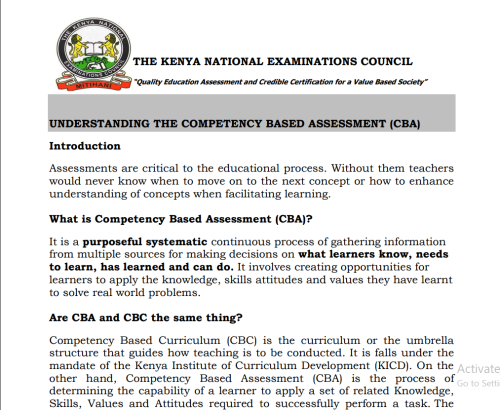
KNEC explained that Competency-Based Assessment (CBA) differs from traditional exams like KCPE by emphasising continuous evaluation rather than one-off tests. “CBA is a purposeful, systematic, continuous process of gathering information from multiple sources to assess what learners know, need to learn, and can do,” the council said.
At Grade 3, the school-based assessment informs learner progress without ranking or placement, allowing all students to proceed to Upper Primary.
For learners transferring schools, the Sub-County Director of Education manages the process using CP2 credentials. Transfers are allowed at Grade 3 but not Grade 6 due to summative assessments, ensuring continuity of records. KNEC affirmed that the MLP portal provides a robust, inclusive system aligned with CBC’s goal of fostering competency-driven education.
Author
Latest News








Advertisement
More on Insights