Advertisement
I had to ‘man-up’ and raise my son with cerebral palsy
Wednesday 19th October, 2022 08:20 AM|
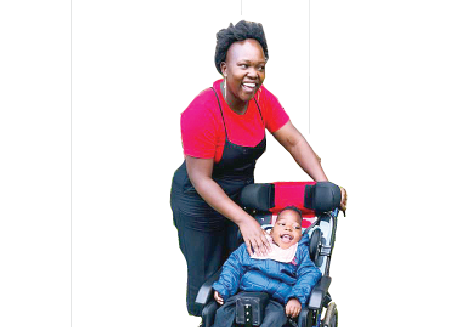
Every mother dreams of bringing forth an abled child after nine months of pregnancy. This is mainly because of the discrimination, rejection, stigma and exclusion that comes with being a parent of a child with disability.
But what do you do when your worst fears turn to reality and you remain as the main provider and carer to your child? This is exactly what 33-year-old Edinah Mokeira faced when she gave birth to her son who has cerebral palsy, three years ago.
In 2019, Mokeira got pregnant with her first-born child. Everything was smooth during her pregnancy period aside from the normal pregnancy hiccups.
“My husband and I were so excited and we really anticipated for the baby. I had an ultra sound and it did not show any problem with the child. So, we just waited for his arrival,” she says.
And after nine months, Mokeira went into labour and was rushed to hospital where her journey to motherhood started.
She shares how she laboured for a long time, but her birth canal could not open up sufficiently to allow the child to be delivered normally. This delay resulted in the unborn baby’s umbilical cord wrapped around his neck, slowly denying him oxygen, blood and other nutrients he needed.
She had to be rushed to the theater where she underwent an emergency caesarean section in order to save the baby. The surgery was successful and baby Shujaa was born.
Delay, ignorance and shocking news
“The baby, however, did not cry as it is normal and the doctors were not so keen on checking why he did not cry and they never took him to an incubator,” she says.
After two hours, Mokeira says the nurses brought the baby and since she was just a first-time mother, she could not spot any abnormalities with her baby.
She says her baby could not breastfeed and the health workers assured her that it is normal for newborns not to feed as they are getting adjusted to their new environment.
She, however, started noticing the differences when the baby started convulsing and having unstable rolling, yellowish eyes.
“It is only when my sister came to visit on the third day that she noticed the baby was not okay after noticing the baby was drooling and severely convulsing,” she says.
When the sister raised her concerns with the doctors, she was told that it was normal and the doctors only came to their rescue when the baby’s condition got worse.
Mokeira and her sister then transferred to a missionary hospital where for the first time, they were treated with urgency and got to know the real problem behind her son’s situation.
“They noticed that he had advanced jaundice and started treatment immediately. They also told us that the child might have some form of disability, but needed more time to confirm,” she says.
After three weeks of being in hospital with her child, not forgetting that she also had a CS wound, which could not heal, which forced her to go back to the theater for a correctional surgery, Mokeira was finally discharged.
Before leaving the hospital, her husband of five years called her to say he never wanted her back to their home.
Mokeira says her husband totally refused to settle their hospital bills and only called to inform her not to go back to their matrimonial home.
From that call, Mokeira knew she was on her own in the parenthood journey.
“It took close to four months to accept that my baby had a disability. I could not understand how he got cerebral palsy, yet I had done everything right,” she says.
With no home and no job, Mokeira had to “man up” and be the provider as well as the carer for her son.
And due to Shujaa’s disability, which needs her unconditional attention, she had to shelve her dreams of getting a fulltime job and resorted to casual labour to give her ample time to be with her son.
“Most potential domestic managers refuse to work for me when they realise they will be looking after a child with a disability, meaning I’m the sole carer. What happens when you’re the only parent? Who will bring food to the table, who will cater for the medical expenses? You are just on your own,” she notes.
Mokeira’s story represents the story of thousands of parents who shoulder the burden of being carers of their children with disabilities, especially those with neurological development disabilities such as cerebral palsy.
Double burden
The full-time care they require means mothers have to quit their jobs to look after their children, leaving them with little to zero support such as psychological and economical.
It is estimated that in Kenya, three in 100 children are living with cerebral palsy.
Aside from the attention they need, children with disabilities have a strict diet guideline, which they need to adhere to.
They also have to take medicine everyday, which costs not less than Sh4,000,and failure to take the drugs might cause convulsions.
“We also have to go for three to four therapy sessions every week. The price per session is also so high,” says Mokeira.
Alex Munyeri from National Council for People with Disability says, generally, parents of children with disability have double burden in taking care of their children in a society that discriminates and stigmatises people with disability.
Munyeri who is a person living with albinism says his family faced rejection from the community after he was born.
“I was called a white man’s son and my father was urged by the community to leave my mother because she had cheated on him and that I was the proof of that illicit relationship. He was ridiculed when he refused,” he says.
And aside from the myths and misconception that accompany children born with disability, Munyere says most parents do not expect a child with disability and are caught by surprise when that happens.
He says it takes a while before they accept their children’s condition while in some instances, some parents reject and abandon the children, leaving all the responsibilities to a single parent.
“In some cases, parents opt to seek help from witchdoctors and fortune tellers. It is difficult for these parents because they were not prepared mentally or physically on how to handle these children,” he says.
Author
Malemba Mkongo
View all posts by Malemba MkongoLatest News








Advertisement
More on Insights