Advertisement
Willis Otieno slams govt over crippling, exploitative debt
Sunday 27th July, 2025 06:23 AM|
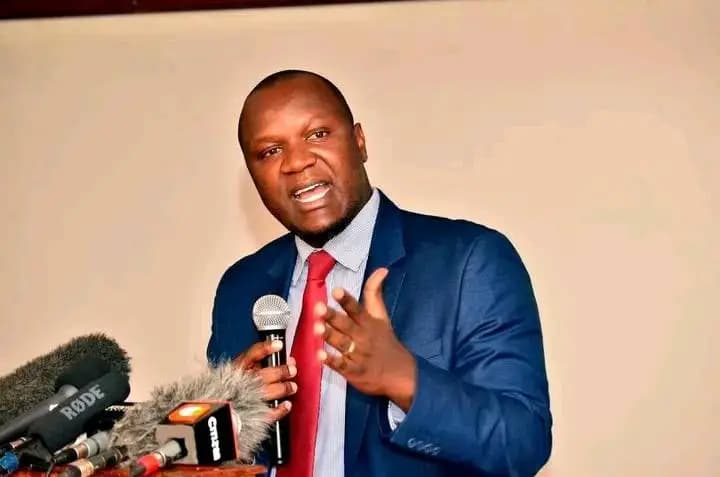
Outspoken lawyer and Safina Party member Willis Otieno has launched a scathing attack on the government over what he described as crippling, odious, exploitative debt, accusing the state of enslaving its citizens through unsustainable borrowing.
Otieno’s comments come amid growing public concern over Kenya’s debt load, which has surged in recent years due to infrastructure spending, pandemic recovery costs, and rising interest rates.
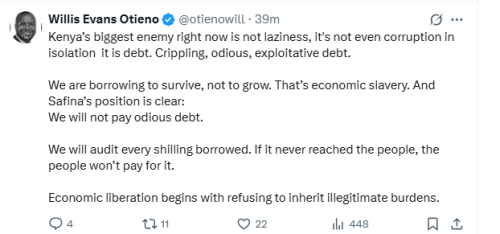
In a hard-hitting statement on his official X account on Sunday, July 27, 2025, Otieno stated that the nation’s biggest threat is no longer corruption or laziness but the growing burden of debt, which he claims offers no real economic benefit to ordinary Kenyans.
“Kenya’s biggest enemy right now is not laziness; it’s not even corruption in isolation; it is debt. Crippling, odious, exploitative debt,” Otieno said, emphasising the urgent need for a national reckoning on the issue.
You Might Also Like
He accused the government of borrowing merely to stay afloat, rather than to fund development projects that would spur long-term growth.
“We are borrowing to survive, not to grow. That’s economic slavery,” he said, painting a grim picture of the country’s financial direction.
Otieno went further to outline Safina’s party firm’s stance on what he termed illegitimate or unjustifiable debts.
“Safina’s position is clear: we will not pay odious debt,” he declared.
He also pledged that a future Safina-led administration would undertake a thorough audit of all loans taken by the government.
“We will audit every shilling borrowed. If it never reached the people, the people won’t pay for it,” Otieno said.
The government has repeatedly defended its borrowing practices, claiming they are necessary to fund essential services and investments.
But Otieno rejected such justifications, insisting that economic liberation can only begin by rejecting illegitimate financial burdens.
“Economic liberation begins with refusing to inherit illegitimate burdens,” he asserted.

Kenya’s debt crisis
Developing countries, including Kenya, are increasingly forced to prioritise debt repayments over development, with 3.4 billion people living in nations whose debt servicing bill exceeds that of key sectors such as health or education.
The UN Conference on Trade and Development (UNCTAD) made the revelation during the recently concluded Fourth International Conference on Financing for Development in Sevilla, Spain, where it urged development partners and governments to prioritise public debt vulnerability as a top concern.
“Public debt can be a powerful tool for development. Governments use it to invest in their people and economies, and pave the way to a better future. But when debt grows too large or becomes too costly, it turns into a burden. That is the current reality for much of the developing world,’’ the UN trade agency said.
The UN agency mentioned that Kenya is among the half of developing nations that spend at least 6.5 per cent of their export revenues to service external public debt.
In the financial year ending June 30, 2025, Kenya spent Ksh1.85 trillion on debt servicing, constituting debt redemption at Ksh843.4 billion and interest payments at Kshh1.1 trillion. This financial year, the government has earmarked Ksh1.1 trillion to pay interest on debt.
This is way below the Ksh702.7 billion allocated for education and Ksh139 billion planned for health in the current financial year.
Author
Latest News


Advertisement
More on Inside Politics