Willis Otieno questions leaders over persistent poor roads across regimes
By Faith Lagat, January 16, 2026City lawyer Willis Otieno has raised concerns over the enduring poor state of roads in Luo Nyanza, despite years of political representation, multiple parliamentary terms, and significant budgets.
He questioned the effectiveness of repeated government “handshakes” and coalitions, which critics say have failed to improve infrastructure in the region.
In a January 16, 2026, post on X, Otieno responded to a post that argued that dilapidated roads, reportedly making up roughly 90% of those in Luo Nyanza, justify continued political loyalty to secure planning and development.
Otieno challenged this logic directly, asking, “If a government requires silence and loyalty before delivering basic infrastructure, is that governance or transactional politics?”
Otieno’s question strikes at the heart of political accountability, challenging the idea that basic services should be contingent on loyalty. He implies that when governments prioritise political allegiance over citizens’ fundamental needs, like roads, schools, and healthcare, they reduce governance to a transactional exercise, where support is bought or coerced rather than earned through competence.
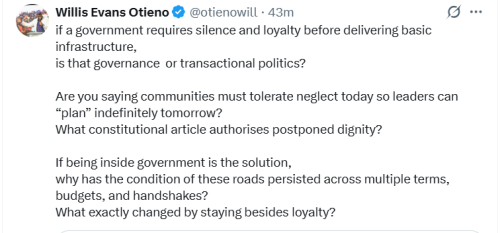
He noted that such a system undermines constitutional principles, delays development, and forces communities to tolerate neglect, raising a critical debate about whether democracy should serve the people or political interests.
He further highlighted the human cost of delays, questioning, “Are you saying communities must tolerate neglect today so leaders can ‘plan’ indefinitely tomorrow? What constitutional article authorises postponed dignity?”
His comments underline growing frustration in the region, where residents continue to face pothole-riddled roads, impassable sections during rains, and disrupted connectivity despite repeated assurances.
Loyalty versus tangible development
Otieno pointed out a core contradiction in arguments for alignment with the ruling coalition. Proponents say staying in government unlocks resources and accelerates projects.
Yet, he asked, “If being inside government is the solution, why has the condition of these roads persisted across multiple terms, budgets, and handshakes? What exactly changed by staying besides loyalty?”
His remarks come amid broader scrutiny of regional development priorities. While some leaders cite ongoing national projects or future promises tied to political alliances, Otieno insists that basic services like reliable roads should not depend on allegiance, framing the issue as a matter of constitutional rights and citizens’ dignity.
The critique aligns with Otieno’s previous interventions on governance issues. In December 2025, he challenged COTU Secretary General Francis Atwoli over remarks linking road accidents to the absence of a National Infrastructure Fund, dismissing such arguments as emotional manipulation and pointing to corruption, mismanagement, and incompetence as root causes.