Advertisement
Salasya dismisses Ruto’s stadium projects as zero work, urges focus on football academies
Sunday 07th June, 2026 03:53 PM|

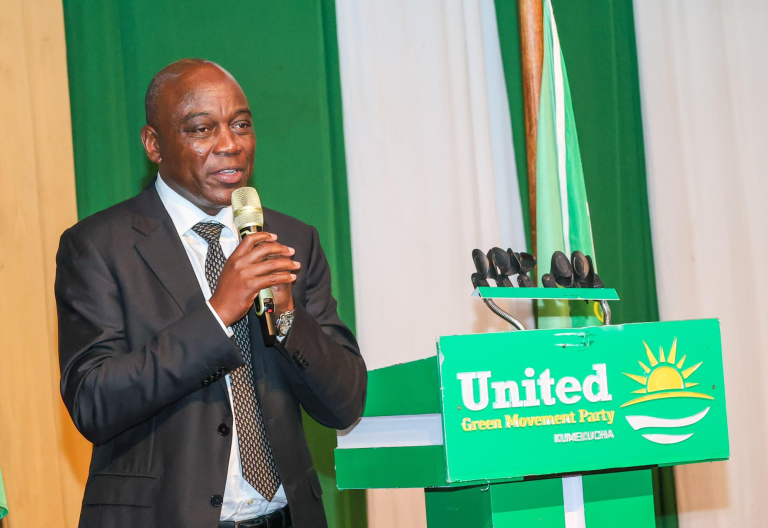
Mumias East Member of Parliament (MP) Peter Salasya has sharply criticised President William Ruto’s nationwide stadium construction programme, terming it “zero work” and economically unproductive.
Taking to his official X account on Sunday, June 7, 2026, Salasya argued that the ongoing investment in stadiums across various counties does little to transform the country’s sports ecosystem or create sustainable economic opportunities for young people.
Instead, he urged the government to redirect resources toward developing football academies and strengthening grassroots talent development structures.
He claimed that Kenya’s sports policy lacks a clear economic vision and accused the administration of prioritising highly visible infrastructure projects over long-term talent nurturing and institutional reform.
You Might Also Like

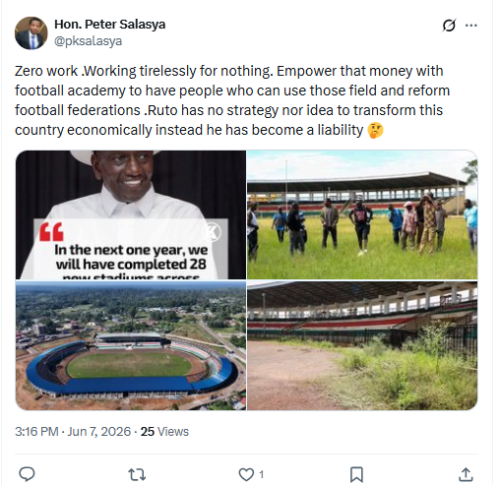
“Zero work. Working tirelessly for nothing. Empower that money with football academy to have people who can use those field and reform football federations. Ruto has no strategy nor idea to transform this country economically instead he has become a liability,” Salasya wrote on X.
Government’s sports infrastructure projects
The government has in recent months defended its stadium construction initiative, stating that improved sports infrastructure is key to nurturing talent, hosting international competitions, and boosting local economies through sports tourism.
Wajir Stadium, which has been constructed to international sporting and event standards, is one of the latest sports infrastructures to have been delivered by the government.
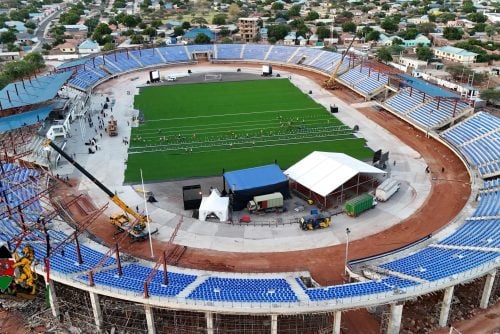
The super-modern stadium is part of a wider initiative by the government to spread national celebrations across the country and to encourage inclusive development in all the regions of Kenya.
The stadium is designed to serve a variety of sports and events. It has a full-size football field, an 8-lane athletics track, VIP lounges, modern changing rooms, and increased spectator stands that are comfortable and safe.
Stadiums abandoned after national holiday celebrations
Salasya’s concerns add to ongoing political discussions around public spending priorities, with leaders raising concerns about the state of some of the sports infrastructures, which are normally abandoned and left to rot away after hosting national events.
Overgrown grass now lines the playing surface and walkways of the historic Masinde Muliro Stadium in Bungoma; iron rails stand silently around deserted sections, while visible signs of neglect continue to eat away at a facility once envisioned as a hub for nurturing sporting talent in Western Kenya.
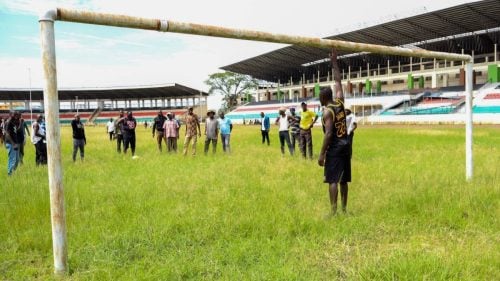
The worrying state of the stadium that staged the 2024 Madaraka Day celebrations on June 1, 2024, has once again brought into sharp focus the long-standing problem of poor management and maintenance of sports infrastructure in Kenya, a challenge that continues to deny thousands of young athletes access to quality training and competition grounds.
What was expected to become a vibrant centre for football, athletics, and youth development now paints a picture of abandonment.
Parts of the facility appear unused, with weeds spreading around the premises, while sections of the structure show signs of deterioration despite the huge public investment made in its construction.
Masinde Muliro–Kanduyi Stadium was contracted for a rehabilitation sum amounting to Ksh799.1 million, a project that Auditor General Nancy Gathungu exposed Sports Kenya for issuing irregular tenders for the refurbishment of stadiums amounting to Ksh1.96 billion in 2024.
The irregular tenders, involving Masinde Muliro Stadium, also relate to the refurbishment of Kericho Green Stadium and Bukhungu Stadium in Kakamega.
Author
Mustafa Juma
View all posts by Mustafa JumaLatest News


Advertisement
More on Inside Politics