Advertisement
Safaricom foreign takeover raises questions over Kenya’s 2027 election security – Ndegwa Njiru
Friday 02nd January, 2026 01:05 PM|

Human rights advocate Ndegwa Njiru has raised concerns over Kenya’s electoral security following Safaricom’s shift to majority foreign ownership.
In a statement shared on X on Friday, January 2, 2025, Ndegwa Njiru questioned the implications this could have on sensitive election data, biometric registers, and mobile banking oversight as the country prepares for the 2027 General Election.
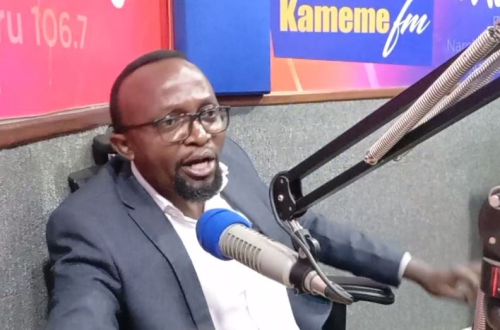
Ndegwa Njiru expressed deep concerns about the integrity of the upcoming electoral process.
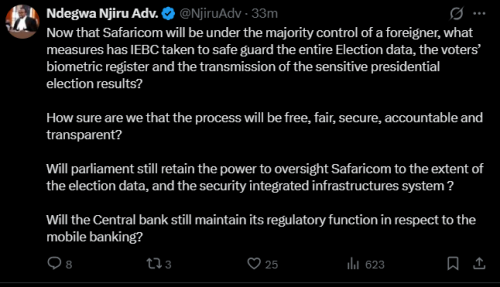
“Now that Safaricom will be under the majority control of a foreigner, what measures has IEBC taken to safeguard the entire Election data, the voters’ biometric votes’ register and the transmission of the sensitive presidential election results?” Njiru asked.
You Might Also Like

He also questioned the ability of the electoral process to remain free and fair under the new ownership structure.
“How sure are we that the process will be free, fair, secure, accountable and transparent?” Njiru added.
The advocate highlighted potential challenges in regulatory oversight. He questioned whether Parliament would still maintain its authority to oversee Safaricom’s operations, particularly regarding election security infrastructure.
“Will parliament still retain the power to oversight Safaricom to the extent of the election data, the security integrated infrastructures?” Njiru said.
Njiru further raised concerns about the role of Kenya’s Central Bank in regulating mobile banking under foreign majority ownership.
“Will the Central bank still maintain its regulatory function with respect to mobile banking?” he asked.
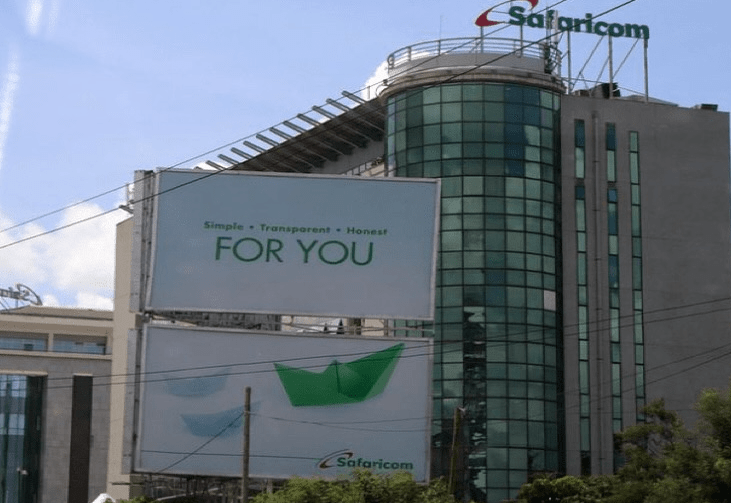
Safaricom, a key player in Kenya’s telecommunications and mobile money sectors, has historically been critical to the security and transmission of election results. Any shift in control raises questions about data sovereignty, security protocols, and national oversight.
Njiru warn that the move could require legislative updates and new safeguards to ensure that electoral integrity is not compromised. He also called for public transparency on what measures will be implemented to protect election data and mobile financial services.
Ownership of Safaricom
The previous ownership of Safaricom was:
- Government of Kenya – 35%
- Vodafone – 40%
- Kenyan public – 25%
However, from now on, Vodacom will hold the largest share at 55 per cent, followed by the Kenyan public at 25 per cent and the government at 20 per cent.
The sale agreement must be approved by the Capital Markets Authority (CMA), the Communications Authority of Kenya (CAK), the Central Bank of Kenya (CBK), the Cabinet, Parliament, COMESA, and the EAC Competition Authority.
The Ksh244 billion that the government will receive from the sale will surpass its annual privatisation target of Ksh149 billion. The amount will not be used to settle debts but will be directed to the National Infrastructure Fund (NIF), which is set to be launched by the President.
Author
Latest News


Advertisement
More on Inside Politics