Advertisement
Raila, Ruto marriage shaky after order
Saturday 12th July, 2025 02:20 AM|
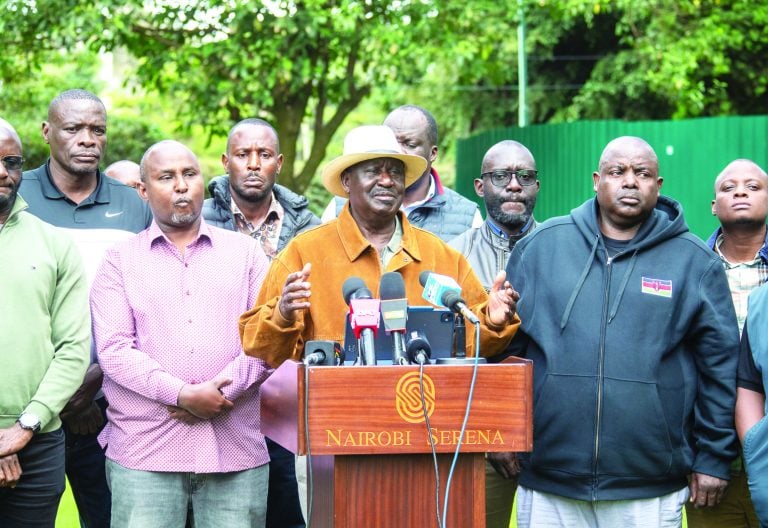
The political bromance between President William Ruto and former Prime Minister Raila Odinga appeared shaky on July 11, 2025, when the latter accused the Head of State of militarising the police.
Raila, who has been cooperating with President Ruto’s Kenya Kwanza outfit through the broad-based government, also criticised the head of state’s shoot-to-maim order during protests.
In a strongly worded statement, Raila denounced what he called a disturbing shift toward militarised policing in the country.
“In a protest or any other environment that requires law enforcement, all the above orders-shoot to kill, maim, disorient or shock citizens are wrong,” Raila observed.
You Might Also Like



He stressed the importance of adhering to legal procedures and safeguarding citizens’ rights, regardless of the circumstances surrounding public dissent.
The ODM leader who has in the recent past maintained a studious silence as police maimed, tortured and killed perceived critics to President Ruto’s government, broke his silence yesterday and described the President’s order as a dangerous and illegitimate move that undermines the rule of law and endangers both citizens and law enforcement officers in the country.
“We must at all times opt for the rule of law and due process and reject the temptation to give police illegitimate and deadly powers over citizens,” said Raila
The ODM leader made a scathing attack on his political soulmate on a day that the Anglican bishops under the stewardship of archbishop Jackson Ole Sapit warned that Kenya is slipping into chaos and lawlessness as violence and political thuggery rise.
Ole Sapit said the country must “pause” and reflect on its direction as he challenged leaders and citizens to consider whether Kenya is on a path to life or death.
“We are seeing our beloved country slowly slipping into unrest, thuggery and chaos,” said Ole Sapit.
While rejecting the shoot-to-kill order, Ole Sapit said police must act within the law.
On his part, Raila warned against the decision by President Ruto and Interior Cabinet Secretary Kipchumba Murkomen to give police authority to shoot to kill or maim during protests and urged the government to prioritise arrests and due process instead of militarised policing.
Raila said the issue of police using excessive force against citizens, even when they are suspected of breaking the law, violates the rule of law and risks escalating violence in the country.
The ODM leader said that everyone remains innocent until proven guilty by a competent court of law, noting that the state should prioritise arrest and arraignment over killing or brutalising suspects.
“This preserves the dignity and respects the human rights of suspects while at the same time confers credibility to the actions of the state,” noted Raila.
His remarks come days after President William Ruto directed security agencies to firmly deal with individuals looting and vandalising businesses during protests.
Speaking in Kilimani during the launch of an affordable housing project, Ruto said such individuals should be shot in the leg, taken to the hospital, and then to court.
“Mtu ambaye anenda kuchoma mali ya watu na kupiga polisi, mtu kama huyo apigwe risasi ya mguu, apelekwe hospitalini kisha kortini. Wasimuue lakini wapige mguu ivunjike, apelekwe kortini,” said Ruto.
This loosely translates to, “Anyone who vandalises any property and attacks a police officer should be shot in the leg, taken to the hospital and the court of law. He should not be killed, but break his leg and take him to court.”
Ruto averred that as president, he would not sit back and allow the country to slide into anarchy as criminals take advantage of protests to loot and vandalise property.
“Mtu anamka kwake anachukua moto akachome mali ya mwingine… apana hio siwezi kubali. Kwa hivyo askari asipige mwananchi risasi kuua, lakini mwalifu ashughulikiwe,” he said.
Before the President’s directive, Murkomen had declared he would stand by officers accused of manhandling protesters even if the charges included murder, noting that he is a lawyer and would defend them to the end.
But yesterday, Raila said a militarised approach to policing endangers both law enforcement officers and suspects, explaining that examples from other African countries have shown that such methods often increase violence.
He urged authorities to uphold constitutional principles in handling protests and other law enforcement activities, noting that respecting human rights strengthens the country’s democratic values.
“As a country, we must at all times opt for the Rule of Law and due process and reject the temptation to give police illegitimate and deadly powers over citizens even when the citizens are perceived to have broken the law,” he said.
Raila further argued that Kenya’s justice system must uphold the fundamental legal principle of presumption of innocence and resist attempts to bypass judicial processes.
“We are all better served as a country when we stick to the principle that everyone is innocent until proven guilty; a determination that can only be made by a competent court of law,” he said.
Calling for an end to state-sponsored brutality, he urged the government to prioritise legal proceedings over violence.
“Let’s prioritise arrests and arraignment in courts over the killing, maiming or brutalising of suspects.
Most of the protests have resulted in deaths, injuries, and abductions, with critics condemning police for brutality and the use of live ammunition on unarmed protesters during the youth-led demonstrations.
At the same time, there have been concerns over the deployment of armed youth groups, ‘goons’, to attack protesters and loot businesses.
The Kenya National Commission on Human Rights (KNCHR) said it recorded 31 deaths and 107 injuries from the most recent demos on Monday, July 7, 2025, in which vandalism cases targeting business premises were also recorded in several towns across at least 15 counties.
Author
Latest News






Advertisement
More on Inside Politics