Advertisement
Orengo demands deep fuel reforms as matatu strike halts
Tuesday 19th May, 2026 04:15 PM|

Siaya Governor James Orengo has called on the government to take urgent action on rising fuel prices, police conduct and economic pressure facing Kenyans. His statement comes as the nationwide matatu strike was suspended for one week following talks between the government and transport operators.
The strike, which disrupted transport in Nairobi and other towns, left thousands of commuters stranded for two days. Protesters blocked roads, lit bonfires and clashed with police in several areas as fuel prices continued to rise. Following negotiations, the Ministry of Interior confirmed that both sides agreed to continue talks while operators resume services.
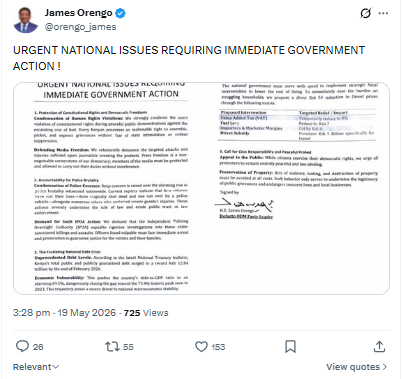
In his statement on May 19, 2026, titled “Urgent National Issues Requiring Immediate Government Action”, Orengo urged the government to respect constitutional freedoms during demonstrations.
“We strongly condemn the overt violation of constitutional rights during peaceful public demonstrations against the escalating cost of fuel,” he said. “Every Kenyan possesses an inalienable right to assemble, picket, and express grievances without fear of state intimidation or violent suppression.”
Attack on journalists
You Might Also Like
He also raised concerns over attacks on journalists covering the protests.
“We vehemently denounce the targeted attacks and injuries inflicted upon journalists covering the protests. Press freedom is a non-negotiable cornerstone of our democracy,” the statement read.
Orengo further expressed concern over police conduct during the demonstrations. Reports indicate that four people died during the unrest – three shot dead and one run over by a police vehicle – while several others sustained gunshot injuries.
“Deep concern is raised over the alarming rise in police brutality witnessed nationwide,” he said. “These actions severely undermine the rule of law and erode public trust in law enforcement.”
He called on the Independent Policing Oversight Authority (IPOA) to act swiftly.
“We demand that IPOA expedite rigorous investigations into these state-sanctioned killings and assaults. Officers found culpable must face immediate arrest and prosecution,” he added.
Debt levels raise pressure
Orengo also linked the protests to Kenya’s worsening fiscal position. According to the latest National Treasury bulletin, public debt stood at Ksh12.84 trillion by February 2026, pushing the debt-to-GDP ratio to 69.5 per cent.
“This trajectory poses a severe threat to national macroeconomic stability,” he warned, noting that rising debt continues to strain households already facing high transport and food costs.
Push for diesel price cut
At the centre of his statement is a proposal to reduce diesel prices by Ksh 54 through coordinated tax and cost adjustments. He outlined a matrix of interventions including:
- Value Added Tax (VAT) reduced temporarily to 0 per cent
- Fuel Levy reduced by Ksh7
- Importers and marketers’ margins cut by Ksh4
- A Ksh5 billion subsidy directed specifically to diesel
Orengo said the government must act quickly to ease pressure on households and businesses that depend on transport.
“The national government must move with speed to implement strategic fiscal interventions to lower the cost of living,” he said.
Transport operators have consistently blamed high diesel prices for making operations unsustainable, especially for matatus, buses and trucks. The government recently reduced diesel prices by Ksh10 per litre and adjusted VAT on petroleum products by 8 per cent, but operators say the relief remains insufficient.
Call for calm
Despite his strong criticism, Orengo urged protesters to remain peaceful.
“While citizens exercise their democratic rights, we urge all protestors to remain entirely peaceful and law-abiding,” he said.
He warned against the destruction of property, saying such actions weaken public support for legitimate grievances and endanger lives.
Transport stakeholders also distanced themselves from violence witnessed during the protests. Operators, including Super Metro and Metrotrans, resumed services after the strike suspension, asking commuters to return to normal travel.
Interior Cabinet Secretary Kipchumba Murkomen said the government recognises the pressure Kenyans face due to global fuel price increases linked to the Middle East crisis. He confirmed that negotiations will continue in the coming days to find a longer-term solution.
Author
Kenneth Mwenda
Kenneth Mwenda is a business, sports, and politics digital writer with over seven years of experience in journalism, covering breaking news, feature stories, and in-depth analysis across a range of beats.
For inquiries, he can be reached at [email protected]
View all posts by Kenneth MwendaLatest News

Advertisement
More on Inside Politics