Advertisement
MP Otiende Omollo hails court verdict on NG-CDF
Saturday 07th February, 2026 09:23 AM|

The Appellate Court’s decision delivered today has pulled the National Government Constituencies Development Fund (NG-CDF) back from the brink, ending months of crippling uncertainty over its legality.
Several MPs led by Rarieda MP Otiende Omollo were happy that by upholding NG-CDF as constitutional, the Court of Appeal has not only restored a critical development pipeline but also reopened a fierce national debate on how far lawmakers should go in shaping development spending at the constituency level.
For Rarieda Otiende Amollo, the ruling represents a lifeline for millions of ordinary Kenyans who rely on the fund for education, health, and basic infrastructure.

Speaking to the People Daily E paper, on February 6, 2026, after the judgment, Amollo framed the outcome as a victory for citizens rather than politicians.
You Might Also Like
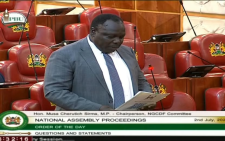


“This was never about shielding MPs,” he said. “Members of Parliament do not benefit personally from NG-CDF. It was about protecting a constitutional mechanism that delivers resources directly to the people.”
Amollo revealed that he led a 12-member legal team in defending the fund, underscoring the complexity of the case and the high stakes involved.
Earlier in his social media sphere, he posted on Facebook and X that.
“As Lead Counsel in the NG-CDF Appeal, I am quite happy with the Court of Appeal verdict, which has upheld the legality & constitutionality of CDF.
This is a win, not for MPs, but for citizens who immensely depend on these decentralised funds.”
For years, NG-CDF has operated under a constitutional cloud, with critics arguing that it violates the separation of powers by allowing legislators to influence development expenditure—traditionally the preserve of the Executive.
Those objections culminated in a series of court challenges that at one point threatened to shut the fund down entirely.
A June 10 deadline loomed, after which NG-CDF operations were expected to cease, throwing constituencies into paralysis.
According to Amollo, the uncertainty was already wreaking havoc on the ground.

Projects were frozen, staff faced job insecurity, and bursary programmes—especially for students in Grades 9 and 10—were left hanging.
Had the court delayed further, NG-CDF risked missing the next budget cycle, potentially locking out thousands of needy students and leaving half-completed classrooms and unpaid contractors scattered across the country.
The ruling now provides clarity. While affirming NG-CDF’s constitutional footing, the court has effectively lifted the paralysis.
Constituencies can resume stalled projects, bursary committees can issue cheques with confidence, and implementers can plan without fear of sudden legal shutdowns.
Evidence of NG-CDF’s impact is already visible. In Tetu Constituency, MP Geoffrey Wandeto says the fund has transformed education infrastructure, with 40 out of 45 primary schools renovated.
Once dilapidated classrooms now boast new iron sheets, tiled floors, fresh paint, and individual lockers.
More than Sh645 million has been invested in education, restoring Tetu’s status as a regional academic hub.
In Homa Bay Town, MP Opondo Kaluma welcomed the verdict as a “milestone judgement” sensitive to the plight of vulnerable children.
He noted that NG-CDF has been central to building school infrastructure and supporting thousands of needy students through bursaries and scholarships, calling the ruling a landmark decision made squarely in the public interest.
Kisumu central MP
The relief has also resonated beyond Parliament. Kisumu Central MP Dr Joshua Oron said the legal limbo had delayed critical operations, particularly bursary and scholarship processing for thousands of applicants in his constituency.
“Like Otiende Amollo and our colleagues, we are happy with the jury,” Oron said, adding that the decision clears the way for urgent support to reach those in need.
Residents echoed the sentiment. Steve Wanda, a Kisumu resident, described the judgement as a bold response to public outcry.
“The courts have listened to the hue and cry of wananchi,” he said. “We thank God for this decision.”
Yet the ruling does more than unlock funds—it sharpens a deeper governance debate.
NG CDF in marginalised areas
Supporters argue NG-CDF remains one of the most effective tools for localised development, particularly in marginalised areas where national and county bureaucracies often move slowly.
Opponents counter that the model still needs structural reform to prevent duplication with devolved functions and to strengthen accountability.
Amollo insists his involvement was driven by principle rather than politics.
Defending NG-CDF, he argues, was about safeguarding a lifeline that touches classrooms, clinics, and households far from Nairobi’s corridors of power.
With the legal fog now lifted, constituencies can plan again, students can hope again, and communities can finally watch projects move from paper to reality.
While the debate over NG-CDF’s long-term design is far from settled, the court has pressed pause on uncertainty at a critical moment.
Author
Latest News








Advertisement
More on Inside Politics