Advertisement
Maraga criticises fuel price interventions, says crisis was government-made
Friday 22nd May, 2026 03:32 PM|

Former Chief Justice David Maraga has sharply criticised the government’s handling of the ongoing fuel situation, accusing President William Ruto’s administration of creating the crisis through overtaxation, rising debt, and opaque fuel arrangements before introducing what he termed superficial relief measures.
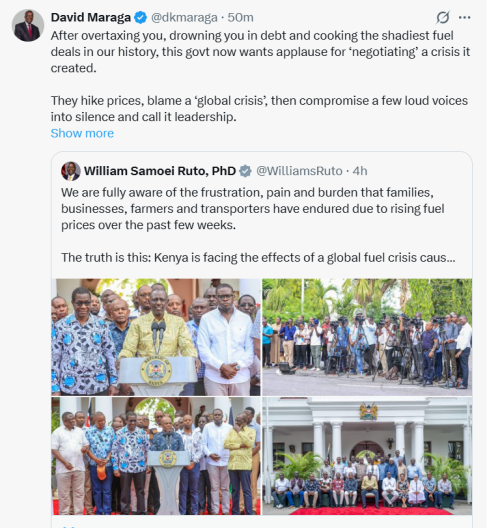
In a statement posted on X on May 22, 2026, Maraga, who is the United Green Movement (UGM) Party’s presidential candidate for 2027, dismissed the government’s interventions as “photo-ops and Ksh10 gimmicks on diesel.”
He argued that the current situation reflects policy failures rather than external pressures alone.
“After overtaxing you, drowning you in debt and cooking the shadiest fuel deals in our history, this govt now wants applause for ‘negotiating’ a crisis it created,” Maraga said.
You Might Also Like



He added that the government had blamed global factors, including the Middle East conflict, while introducing short-term fixes that do not address underlying structural issues.
“They hike prices, blame a ‘global crisis’, then compromise a few loud voices into silence and call it leadership,” he stated.
Fuel crisis response and government position
The remarks came shortly after President William Ruto addressed the nation and held talks with transport stakeholders at State House, Mombasa, on the fuel pricing situation.
Ruto acknowledged the burden of rising fuel costs on households, businesses, farmers, and transport operators, attributing the situation to a global fuel crisis linked to geopolitical tensions affecting supply chains and pricing.
He stated that the government had spent Ksh28.19 billion on fuel price stabilisation and VAT relief measures in recent pricing cycles. According to the president, without these interventions, super petrol would retail at Ksh230 instead of Ksh214, diesel at Ksh277 instead of Ksh232, and kerosene at Ksh270 instead of Ksh191.
To further cushion consumers, Ruto directed a Ksh10 reduction per litre of diesel for the June–July pricing cycle and announced additional reforms in the transport sector, including discussions on lending terms, insurance, and regulatory adjustments affecting operators.
G-to-G fuel framework
The president defended the Government-to-Government (G-to-G) fuel import arrangement, stating that it has helped stabilise supply, reduce pressure on foreign exchange, and ensure consistent availability of petroleum products.
He urged Kenyans to remain patient, warning against politicisation of what he described as a global economic challenge affecting many countries.
However, the G-to-G model has continued to attract scrutiny. Critics have raised questions about transparency, pricing structures, and the concentration of import arrangements within limited supply channels. Concerns have also been raised over whether the framework adequately addresses domestic taxation and structural inefficiencies in fuel pricing.
The exchange between Maraga and the president highlights growing political divisions over the management of fuel prices and broader economic policy direction.
While the government maintains that external global factors are the primary driver of rising fuel costs, critics argue that domestic policy decisions, including taxation and procurement structures, play a significant role.
Author
Latest News

Advertisement
More on Inside Politics