Advertisement
How Hustler Fund fell from lofty, glossy Kenya Kwanza mantra to big flop
Tuesday 05th August, 2025 01:00 AM|

The 2022 General Election campaigns were a battle of socio-economic ideologies with each of the two main contenders, then Deputy President William Ruto and Orange Democratic Movement (ODM) leader Raila Odinga, endearing themselves as ultimate champions of economic revolution and antidotes to the high cost of living.
As the campaigns got to the final stretch when the country was almost yawning with campaign fatigue, there were key taglines to remember and relate to each candidate.
While Ruto became synonymous with the Hustlers Fund- a pledge to dispense microloans straight to mobile phones “at single-digit interest,” Raila, on the other hand, would be remembered for the Ksh6,000 cash transfer promise in what was famously referred to as “Elfu sita” – a monthly stipend to families as a social protection program.
When Ruto was declared president on August 15, 2022, just six days after the polls, it appeared the Hustler Fund had resonated more with the electorate.
You Might Also Like

Launched on November 30, 2022, the Financial Inclusion Fund—commonly known as the Hustler Fund—was billed as a cornerstone of the Kenya Kwanza bottom-up economic transformation agenda.
It aimed to empower low-income earners, informal traders, youth, and small business owners by offering accessible, affordable credit.
But, less than three years later, the Fund faces growing scrutiny—and outright condemnation.
Bleak picture
A recent report by the Kenya Human Rights Commission (KHRC), titled “Failing the Hustlers,” has painted a bleak picture. Despite disbursing more than Ksh9.6 billion by the end of 2023, the Fund has had no measurable impact on job creation or enterprise growth.
It is now mired in a 68.3% default rate, economically unviable loan terms, weak oversight, and political interference.
KHRC has called for the immediate abolishment of the Hustler Fund, terming it a politically driven and structurally flawed initiative that has instead trapped millions of Kenyans in a debt cycle.
The Commission estimates that taxpayers have absorbed 71.5% of the losses.
“Loan sizes ranging between Ksh500 and Ksh1,000 were too little to launch or grow businesses. The repayment period of just 14 days was unrealistic. There was no regulatory framework for recovery,” the report reads.
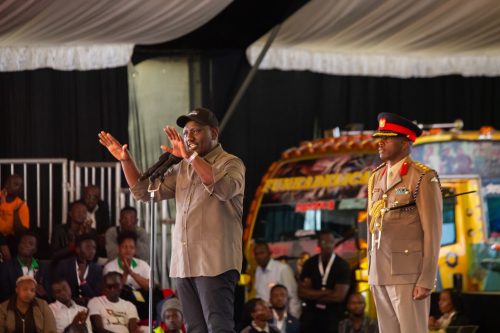
“It has become an economic sinkhole.”
The report further criticised the Fund’s opaque governance.
The Office of the Auditor General was unable to issue an audit opinion due to missing documentation and unverified transactions.
No publicly disclosed formula existed for loan allocation or repayment tracking, and oversight remained centralised in Nairobi—detached from the grassroots population it claimed to serve.
A separate article published by The Conversation in November 2024 described the Hustler Fund as a “flop.”
By August 2024, over 21 million Kenyans had borrowed from the fund, yet 19 million had defaulted. The defaulted amount by October 2023 stood at Ksh10 billion—roughly 27% of total disbursements.
This rate dwarfs those of formal lenders. While commercial banks report default rates near 15 per cent, some non-bank digital lenders like Tala report rates as low as five per cent.
“The key problem is that most borrowers use the loans for household consumption—not for business,” observed Eric Magale, a postdoctoral research fellow at the University of Pretoria.
“Nearly 70% of small business owners who accessed the microloans in 2023 spent them on household needs. Only 18.1% used the funds for business.”
Unconstitutional fund
Busia Senator Okiya Omtatah has dismissed the Hustler Fund as not only ineffective but unconstitutional.
He argues that public funds cannot be taken from the Consolidated Fund to establish another fund unless explicitly provided for by legislation.
“The Hustler Fund is financed annually through allocations from the National Treasury—money that should fund the national budget, not a separate initiative,” Omtatah said.
“It’s a failure to follow the constitutional edicts on public finance.”
He noted that under Article 225 of the Constitution, Parliament is required to establish the National Treasury through an Act of Parliament.
“Yet there is no such Act. The Treasury exists merely as part of a statute. And who appoints the CS and PS of the Treasury? The president. So, in effect, the president is the treasurer.”
President Ruto assumed power amid soaring food and fuel prices, high youth unemployment, and a mounting public debt crisis.
He promised to fix the economy, tackle corruption, entrench good governance, and uphold the Constitution.
Instead, critics say the cost of living has worsened. Fuel and food subsidies were swiftly removed, while taxes have risen sharply.
The signing of the Tax Amendment Act and the Tax Procedures Act in December 2024 introduced sweeping changes—including increased VAT and excise duties—raising the cost of consumer goods and crippling many businesses.
Kitui Rural MP David Mboni Mwalika castigated Ruto’s administration for failing Kenyans.
“He promised jobs, but there are none. He vowed to fight corruption, but it has flourished.”
His Kathiani counterpart, Robert Mbui, echoed the frustrations, saying, “Ruto should stop killing our sons and daughters and raiding our payslips.”
According to Human Rights Watch, Ruto’s government has shown growing intolerance to dissent.
Protests over the high cost of living have been met with excessive force, arbitrary arrests, and harassment of civil society leaders. The right to peaceful protest, guaranteed under the Constitution, is increasingly under threat.
Activist Mwanase Ahmed accuses the government of deploying goons alongside police to sabotage peaceful protests.
“They want to portray protestors as violent to justify repression,” she said.
She also decried the erosion of independent institutions.
“The Executive has swallowed the Judiciary, Legislature, and oversight bodies. Dissent is being silenced.”
The education sector has not been spared.
The Student-Centred Funding Model (SCFM), introduced in May 2023 to ease financial burdens in higher education, has instead caused confusion and disillusionment.
The model grouped students into financial bands, but many were placed in high bands, leaving them with unaffordable fees.
Discriminatory model
Widespread protests erupted. The Kenya Human Rights Commission filed a petition challenging the model, calling it discriminatory and unconstitutional.
President Ruto attempted to quell the backlash by directing universities to recall admission letters and reissue them based on household affordability. But the damage was done. The High Court eventually suspended implementation of the model.
Despite the mounting criticism, not everything under Ruto’s administration has been gloomy.
For instance, it was stunningly beautiful watching ecstatic Kenyan fans perform the Mexican wave at the packed Kasarani Stadium as the National Team Harambee Stars kicked off their 2024 African Nations Championship (CHAN) campaign against DR Congo on Sunday, August 3, 2025.
But it was even more breathtaking as the Atlas Lions of Morocco and the Palancas Negras of Angola battled it out at Nyayo Stadium under floodlights illuminating the green pitch and surrounding areas, creating a captivating atmosphere even for television viewers.
And as Harambee stars marked their long-awaited debut at Chan with a statement 1-0 victory over two-time champions DR Congo, the weekend scenes were undoubtedly historic and classic as the country opened a new chapter in sporting activities, given the limited experience in hosting major football tournaments.
Having missed out on a number of opportunities, such as losing the chance to host the CHAN 2018 and the 1996 Africa Cup of Nations for failing to meet the Confederation of African Football (CAF) President William Ruto’s administration can relish the moment as a great achievement.
The tournament was made possible by a massive investment in sports infrastructure. According to Defence CS Soipan Tuya, the first phase of renovations at Kasarani Stadium alone cost Sh3.6 billion. Other upgrades include:
Ksh3.1 billion for Kasarani Phase 2 (AFCON eligibility), Ksh1.1 billion for Nyayo Stadium, Ksh3.5 billion earmarked for Kipchoge Keino Stadium; Ksh582 million and Ksh490 million for Police Sacco and Ulinzi training complexes, respectively.
“Hosting CHAN is not just about sports. It’s about putting Kenya on the continental map and unlocking economic opportunities,” said Tuya.
Football legend John Bobby Ogolla called it “massive” and a sign of renewed continental respect.
Author
Reuben Mwambingu
View all posts by Reuben MwambinguLatest News



Advertisement
More on Inside Politics