Advertisement
World Bank: Fragile states locked in stagnation as poverty, conflict deepen
Sunday 24th August, 2025 07:28 AM|
The World Bank’s latest report has raised alarm over worsening conditions in fragile and conflict-affected states (FCS), warning that many of these economies remain trapped in cycles of stagnation, poverty, and escalating conflict.
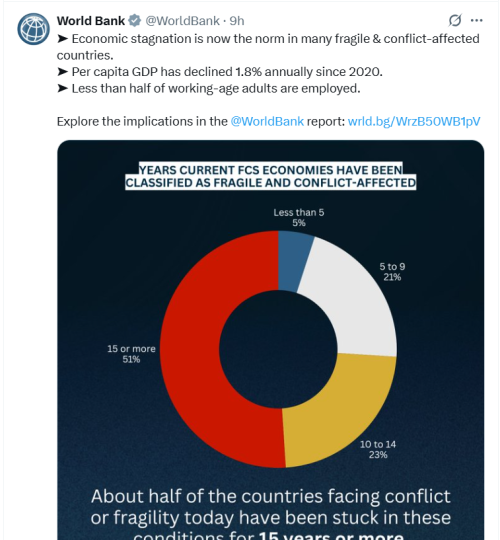
The report, titled Fragile and Conflict-Affected Situations: Intertwined Crises, Multiple Vulnerabilities, reveals that since 2020, per capita GDP in these countries has been shrinking by an average of 1.8 per cent annually.
Employment rates remain bleak, with less than half of working-age adults in meaningful work. As a result, nearly 40 percent of the population in these regions lives in extreme poverty—a figure projected to rise to 60 percent of the global extreme poor by 2030, up from 50 percent in 2024.
Conflict escalation, economic fallout
The findings show that fragility is proving stubborn, with nearly three-quarters of affected states classified as fragile for more than a decade. Weak institutions, minimal fiscal space, and overlapping shocks—from armed conflict and natural disasters to volatile commodity prices and global downturns—continue to hinder growth.
You Might Also Like
Conflict remains the most devastating factor. The frequency and lethality of wars and clashes have tripled since the early 2000s, with high-intensity conflicts wiping out up to 20 per cent of per capita GDP within five years of outbreak.
Social indicators tell a similarly grim story: life expectancy is seven years shorter than in other developing nations, infant mortality is more than double, and children achieve only six years of schooling on average. Learning poverty is widespread, while fragile health systems are increasingly disrupted by conflict.
“Conflict is surging, and its effects are devastating. On a five-year basis, the frequency and lethality of conflicts have more than tripled since the early 2000s. Beyond the immense human toll, the economic impact is staggering: high-intensity conflicts are typically followed by a cumulative drop of about 20 per cent in GDP per capita after five years, relative to pre-conflict projections,” read the World Bank report.
The report estimates that nearly 200 million people—about one in five in these countries—are experiencing acute food insecurity. Rising debt vulnerabilities have compounded the crisis, with 70 percent of FCS economies now at high risk of debt distress.
Untapped potential and global responsibility
Despite the bleak picture, the World Bank notes that these regions hold untapped opportunities, including natural resources, youthful populations, and prospects for tourism once peace takes root.
It is calling for tailored policies and sustained international engagement to unlock resilience. Recommendations include concessional financing, debt relief, stronger governance, and investments in education, healthcare, and infrastructure. Private sector development is also seen as vital for job creation and long-term growth.
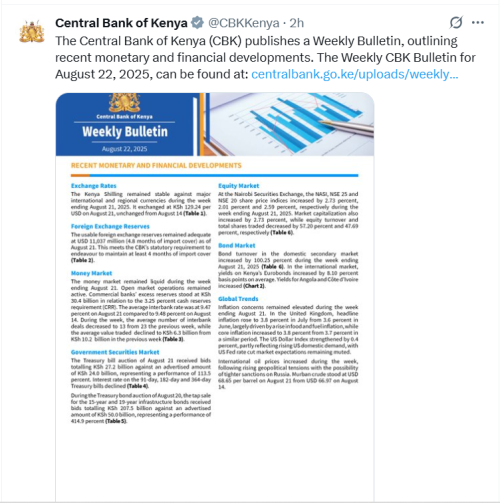
Closer to home, Kenya is cited as an example of resilience. On August 21, 2025, the Central Bank of Kenya (CBK) reported that the shilling held steady at 129.24 against the US dollar, supported by foreign exchange reserves of USD 11.037 billion—equivalent to 4.8 months of import cover. This stability, despite global turbulence, reflects prudent management and sound macroeconomic policies.
“The usable foreign exchange reserves remained adequate at USD 11,037 million (4.8 months of import cover) as of August 21,” the CBK noted, underlining that the reserves provide a critical buffer against external shocks.
The World Bank, however, warns that unless urgent action is taken, many fragile and conflict-affected states will remain locked in stagnation, with poverty and conflict deepening well into the next decade.
Author
Latest News






Advertisement
More on Business