Why energy prices could reverse Kenya’s economic gains in 2026-World Bank
By Aloys Michael, May 1, 2026Kenya’s fragile economic recovery is facing a renewed threat as global energy shocks trigger what economists are calling a second wave of inflation, one that could erode household incomes, strain public finances, and complicate monetary policy in 2026.
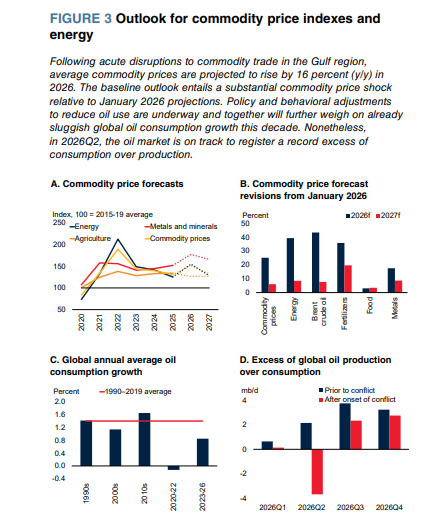
A new World Bank April 2026 Commodity Markets Outlook report indicates global commodity prices are set to rise sharply in 2026, driven largely by disruptions in energy markets following geopolitical tensions in the Middle East.
For countries like Kenya, net importers of fuel, the ripple effects could be immediate and severe.
“Average commodity prices are projected to rise by 16 per cent this year,” the report notes, warning that energy prices alone are expected to jump by 24 per cent in 2026, the steepest increase in years.
According to the World Bank, oil prices are the key contributor. After averaging Ksh8,900 per barrel in 2025, Brent crude is now forecast to average Ksh11,000 per barrel in 2026, with the World Bank cautioning that prices could climb as high as Ksh12,300 to Ksh14,800 per barrel if supply disruptions persist.
For Kenya, where fuel imports are a major driver of inflation, the implications are stark.
Energy costs sit at the base of Kenya’s price structure. Higher oil prices quickly feed into transport costs, electricity tariffs, and ultimately food prices, a transmission mechanism that disproportionately affects low-income households.
“Rising energy costs are likely to drive the average inflation rate to a four-year high across emerging markets and developing economies (EMDEs),” the report warns.
To add, Inflation in these economies, which had been expected to ease, is now projected to climb to 5.1 per cent in 2026, reversing earlier gains.
In Kenya, where the cost of living has already been elevated by food and fuel price pressures, analysts say the new shock could reignite inflation just as it was beginning to stabilise.
For informal sector workers, who make up the majority of Kenya’s labour force, the impact is immediate. Rising fuel prices mean higher transport fares, while food inflation squeezes already thin margins.
Growth under pressure
The inflation surge is not happening in isolation. The same forces pushing prices higher are also weighing on economic growth.
The World Bank has downgraded growth projections for EMDEs to 3.6 per cent in 2026, down from earlier expectations, citing the combined impact of higher energy costs and global uncertainty.
“Growth prospects have been materially dampened due to much higher energy and broader commodity prices globally,” the report states.
For Kenya, this presents a double bind: slower growth reduces job creation and incomes, while higher inflation erodes purchasing power.
Compared to some Sub-Saharan African peers, Kenya’s diversified economy offers some resilience. However, like many commodity-importing nations in the region, it remains highly exposed to external price shocks.
Meanwhile, the unfolding crisis is placing the Central Bank of Kenya in a difficult position.

On one hand, rising inflation typically calls for tighter monetary policy, higher interest rates to curb demand and stabilise prices. On the other hand, raising rates risks choking off already fragile economic growth.
The World Bank notes that higher energy prices are likely to push central banks toward more restrictive monetary policy stances even as growth weakens.
Kenya’s Treasury also faces mounting pressure. The country’s fuel pricing mechanism, designed to cushion consumers through subsidies, could come under strain if global oil prices remain elevated. Sustaining subsidies would widen the fiscal deficit, while removing them risks triggering public backlash through higher pump prices.
Ultimately, the burden of the inflation surge will fall most heavily on ordinary Kenyans.
The World Bank warns that rising commodity prices will curb real income growth and squeeze demand across commodity-importing economies.
For households already grappling with high food and transport costs, the second wave of inflation could deepen economic hardship and widen inequality.
Unless global energy markets stabilise, the World Bank says Kenya may find itself navigating a prolonged period of high inflation and subdued growth, a stark reminder of how distant geopolitical shocks can quickly translate into local economic pain.