Advertisement
Treasury secures Ksh290B to beat 2028, 2032 Eurobond debt deadline
Friday 20th February, 2026 02:29 PM|

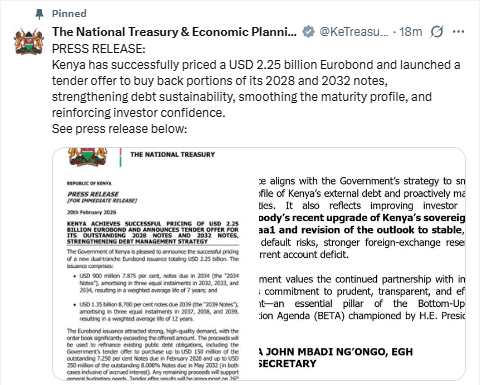
In a fresh borrowing move, the government has mobilised Ksh290 billion to manage Eurobonds set to mature in 2028 and 2032, providing relief to the country’s debt schedule.
In a statement on Friday, February 20, 2026, the treasury said the government raised the money from international markets through a fresh bond sale.
“The government of Kenya is pleased to announce the successful pricing of a new dual-tranche Eurobond issuance totalling $2.25 billion,” the statement read in part.
The proceeds have been earmarked to partly refinance existing debts, which mature in 2028 and 2032, and to bridge the budget deficit ahead of the 2026/2027 budget cycle.
You Might Also Like

Kenya has been named alongside several African countries, including the Ivory Coast and Congo, which have returned to international markets after borrowing conditions improved in recent weeks.
According to the treasury, the government issued Ksh116 billion in seven-year bonds and Ksh168 billion in 12-year bonds, attracting strong investor interest.
“The Eurobond issuance attracted strong, high-quality demand, with the order book significantly exceeding the offered amount,” the treasury said.
The issuance is aligned with the government’s strategy to smooth the maturity profile of Kenya’s external debt and proactively manage public debt liabilities.
It comes at a time when global borrowing conditions have slightly improved, making it easier and cheaper for countries to access international financing compared to previous years.

Debt relief?
Similarly, credit rating agencies such as Moody’s have reacted positively in recent months, noting that Kenya’s near-term risk of default has reduced despite the country’s high debt.
In its latest report, Moody’s noted improvements in Kenya’s external liquidity, a narrower current account deficit, and a more stable shilling.
Moody’s Ratings in January 2026 upgraded Kenya to B3 from Caa1, citing lower near-term default risk, but revised the outlook to stable, while at the same time, the Fitch rating agency affirmed its B- rating with a stable outlook.

“It also reflects improving investor confidence, following Moody’s recent upgrade of Kenya’s sovereign rating to B3 from Caa1 and revision of the outlook to stable,” the statement reaffirmed.
The move reflects a decline in near-term default risk, thanks to stronger foreign reserves and better access to international capital markets.
Under Moody’s scale, Caa1 still signals high credit risk, meaning the country remains vulnerable to economic shocks and may face difficulty meeting debt obligations during stress periods. However, the upgrade from B3 indicates a reduction in default risk, even if Kenya remains far from investment-grade status.
The agency noted that Kenya’s return to international bond markets has helped smooth debt repayment schedules and lower refinancing pressures.
By the end of 2025, foreign reserves had risen to Ksh1.57 trillion, or 5.3 months of import cover, up from Ksh1.2 trillion in 2024.
Author
Latest News








Advertisement
More on Business