Advertisement
New climate economy: Why banks, insurers and investors are becoming disaster responders
Wednesday 22nd July, 2026 04:27 PM|
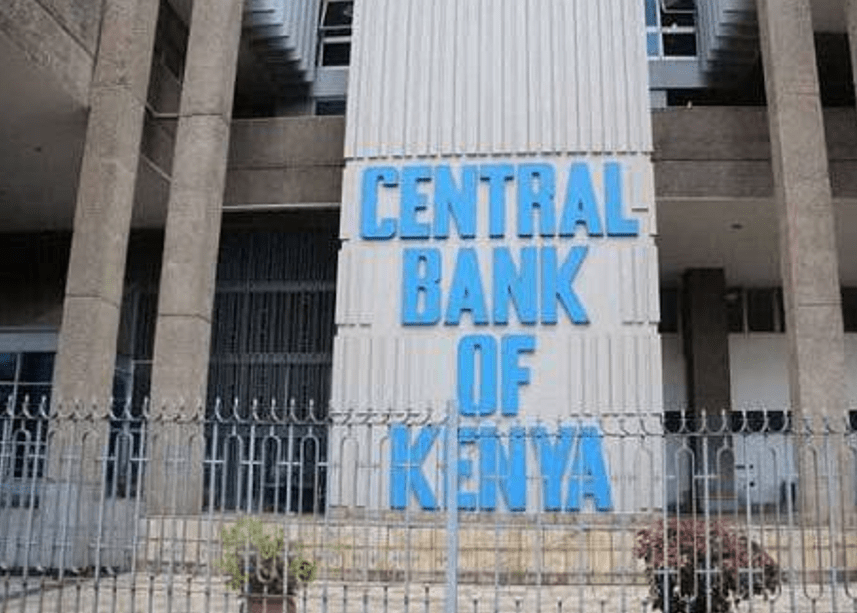
Kenya is seeking to redefine disaster response by shifting part of the financial burden from taxpayers to banks, insurers and private investors, marking a fundamental change in how the country prepares for increasingly costly climate disasters.
The Kenya Disaster Risk Financing Strategy 2026-2030 argues that governments alone can no longer finance the mounting costs of floods, droughts and other climate-related shocks, particularly as public debt rises and international aid declines.
Instead, the strategy proposes a new financial architecture in which commercial banks, insurance companies, pension funds and capital markets become central players in building climate resilience through lending, insurance products, blended finance and innovative financial instruments such as catastrophe bonds.
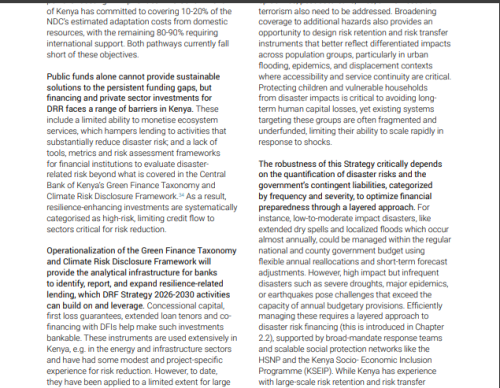
“Public funds alone cannot provide sustainable solutions to the persistent funding gaps,” the strategy states, warning that financing disaster resilience requires far greater private-sector participation.
You Might Also Like


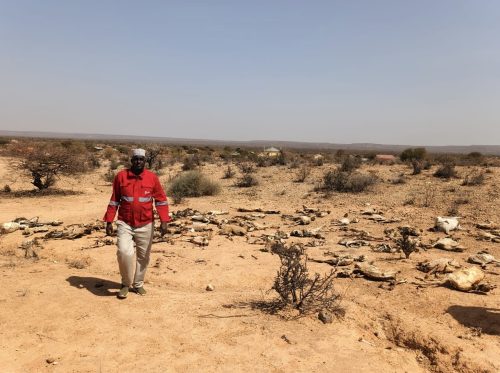
The report comes as Kenya faces escalating climate risks. Between 2017 and 2023, the government spent nearly Ksh23.87 billion on emergency relief alone, excluding reconstruction costs, while the devastating 2021-2023 drought and the 2023-2024 floods inflicted billions of shillings in additional economic losses.
At the same time, shrinking fiscal space and declining official development assistance are limiting the government’s capacity to respond. The strategy concludes that financing resilience must increasingly become a business opportunity rather than solely a government obligation.
One of its most ambitious proposals is expanding resilience lending, encouraging banks to finance projects that reduce disaster risks before they occur. These include watershed restoration, flood-control infrastructure, climate-smart agriculture, mangrove regeneration and drought-resilient water systems.
However, the report acknowledges that financial institutions have been reluctant to support such investments because they are often viewed as commercially risky.
“Resilience-enhancing investments are systematically categorised as high-risk, limiting credit flow to sectors critical for risk reduction,” the strategy says.
F/X
Disaster financing
To overcome that barrier, the government plans to expand the use of blended finance, combining public funds with private capital to reduce investment risks. The strategy also proposes greater use of first-loss guarantees, concessional finance, co-financing with development finance institutions and longer loan tenors to make resilience projects commercially viable.
“Concessional capital, first loss guarantees, extended loan tenors and co-financing with DFIs help make such investments bankable,” the report notes, adding that these financing tools have already demonstrated success in Kenya’s energy and infrastructure sectors but remain underused in disaster resilience.
Insurance markets are also expected to play a much larger role. The strategy calls for expanding sovereign insurance, agricultural insurance and livestock insurance while exploring catastrophe bonds, capital market instruments that transfer disaster risk from governments to global investors.

Unlike traditional emergency funding, catastrophe bonds provide pre-arranged financing that is automatically released when specified disaster triggers are met, reducing dependence on slow post-disaster budget reallocations.
The report argues that Kenya’s future disaster financing should rely on a risk-layering approach, matching different financial instruments to different types of disasters. Frequent, lower-cost emergencies would continue to be financed through government budgets and contingency funds, while rarer but catastrophic events would increasingly be covered through insurance and capital-market products.
Private finance is also expected to support stronger climate disclosure across the financial sector. The strategy links implementation of Kenya’s Green Finance Taxonomy and Climate Risk Disclosure Framework to better identification of resilience investments and greater lending to climate adaptation projects.
The shift reflects a broader transformation in climate economics. As disasters become more frequent and expensive, the strategy argues that financial resilience can no longer depend solely on emergency government spending or humanitarian aid. Instead, banks, insurers and investors are being positioned as frontline actors in protecting economies against climate shocks.
Author
Latest News






Advertisement
More on Business