Advertisement
The Ksh1.2B loan at the centre of WPP Scangroup’s shareholder revolt
Monday 08th June, 2026 01:28 PM|
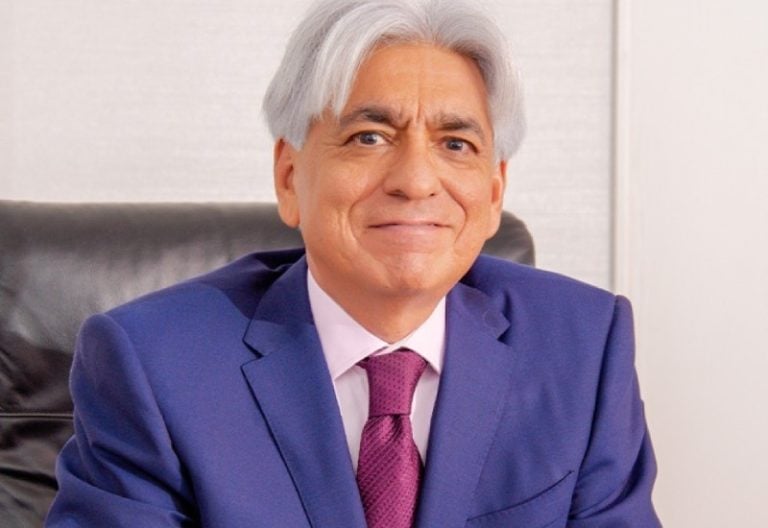
Bharat Thakrar spent more than four decades building WPP Scangroup into one of Africa’s largest marketing communications businesses. Today, he finds himself leading a campaign against the very board overseeing the company he helped create.
On Monday, June 8, 2026, minority shareholders of WPP Scangroup vote on resolutions seeking the removal of the company’s entire board. The outcome was never really in doubt. UK-based advertising giant WPP Plc controls 56.26 per cent of the Nairobi-listed firm and has enough voting power to defeat the proposals.
But for Thakrar and the investors backing him, the vote was never just about winning.
“I built this company. I’ve watched its value fall 62 per cent in four years. Today its minority shareholders vote to hold the board to account, a vote we cannot win but will not stay silent on,” Thakrar wrote on X ahead of the meeting.
You Might Also Like
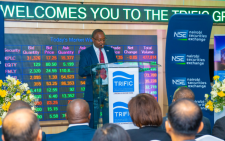

The post accompanied a lengthy opinion article in which the former chief executive accused WPP of neglecting the smaller markets that once helped build its global presence.
From African success story to shareholder revolt
The dispute centres on a company that was once regarded as one of Africa’s leading advertising and communications groups.
Founded in Kenya and listed on the Nairobi Securities Exchange (NSE), WPP Scangroup expanded across the continent under Thakrar’s leadership. The company employed more than 1,000 people, paid regular dividends and built operations in several African markets.
WPP first acquired a minority stake in Scangroup in 2008 before increasing its ownership to majority control.
Today, shareholders backing the board removal motion argue that the company’s fortunes have changed dramatically.
According to figures cited by Thakrar, WPP Scangroup’s share price has fallen about 62 per cent since early 2021. Gross profit has dropped by more than a third to roughly Ksh1.5 billion, while cumulative trading losses have exceeded Ksh3 billion over the past four years.
The company has exited Nigeria and Tanzania, sold its South African operations and lost several major clients, including Airtel, KCB Group, Equity Bank and NCBA.
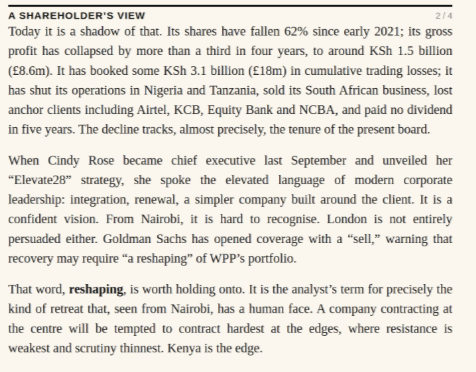
Perhaps most significant for investors, no dividend has been paid in five years.
Revenue has also declined sharply. Shareholder activists point to a fall from roughly Ksh7 billion in 2021 to about Ksh2 billion in recent years, while annual losses have continued to widen.
For critics of the current board, the figures speak for themselves.
The Ksh1.2B loan under scrutiny
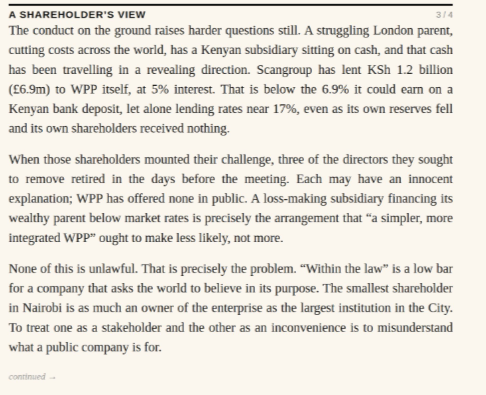
A key issue raised by shareholders concerns a Ksh1.2 billion loan extended by WPP Scangroup to its parent company.
The loan reportedly earns interest of 5 per cent.
Critics argue that the rate is below what the company could earn through local bank deposits and significantly below prevailing commercial lending rates in Kenya.
Thakrar highlighted the arrangement in his opinion piece.
“A struggling London parent, cutting costs across the world, has a Kenyan subsidiary sitting on cash, and that cash has been travelling in a revealing direction,” he wrote.
The transaction has become a focal point in the debate over whether decisions taken by the controlling shareholder are serving the interests of all investors.
No claims of illegality have been made. However, minority shareholders argue that the issue raises broader questions about governance and accountability.
WPP’s global strategy meets local concerns
The shareholder revolt comes as WPP pursues a global restructuring programme under chief executive Cindy Rose.
The strategy, known as Elevate28, aims to simplify operations, integrate businesses and improve efficiency across the group.
Supporters see the plan as necessary in a rapidly changing advertising industry increasingly shaped by artificial intelligence and digital transformation.
Yet critics argue that smaller markets risk bearing the cost of those changes.
In his article, Thakrar suggested that global restructuring often affects peripheral markets most severely.
“A company contracting at the centre will be tempted to contract hardest at the edges, where resistance is weakest and scrutiny thinnest. Kenya is the edge,” he wrote.
The comment reflects a wider concern among some investors that African subsidiaries can become vulnerable when multinational companies focus primarily on priorities set in London, New York or other global headquarters.
Beyond WPP Scangroup, the dispute raises a question relevant to investors across emerging markets.
What protections exist when minority shareholders disagree with a controlling shareholder?
Because WPP owns a majority stake, it can effectively determine the outcome of shareholder votes. That reality has led some investors to argue that the Nairobi AGM was less about changing the board and more about forcing a public discussion on value destruction and governance.
“The smallest shareholder in Nairobi is as much an owner of the enterprise as the largest institution in the City,” Thakrar wrote.
The board is expected to survive the challenge. WPP’s voting power makes that outcome almost certain.
But the campaign has succeeded in putting uncomfortable questions into the public domain.
For investors who have watched the share price decline, dividends disappear and operations shrink, the vote represents an opportunity to demand answers.
The arithmetic favours WPP. The debate over accountability is likely to continue long after the AGM has ended.
Author
Kenneth Mwenda
Kenneth Mwenda is a business, sports, and politics digital writer with over seven years of experience in journalism, covering breaking news, feature stories, and in-depth analysis across a range of beats.
For inquiries, he can be reached at [email protected]
View all posts by Kenneth MwendaLatest News







Advertisement
More on Business