Advertisement
Single share trading kicks off at the NSE
Friday 08th August, 2025 02:46 PM|

The Nairobi Securities Exchange (NSE) has ushered in a transformative era for retail investors with the launch of single-unit share trading.
The move eliminates the previous requirement of buying or selling shares in multiples of 100, lowering the entry barrier for Kenyans seeking to participate in the stock market.
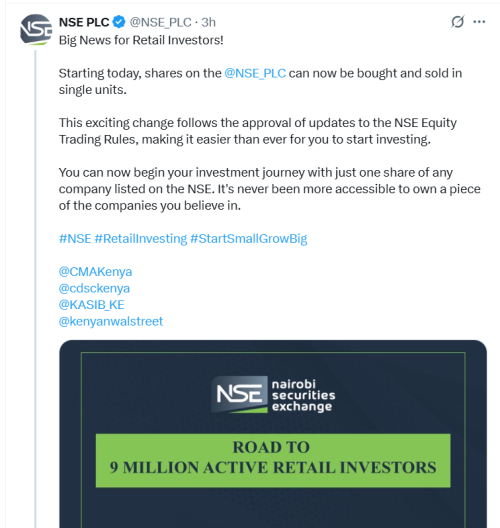
Announced via an NSE post on X on August 8, 2025, the reform follows the approval of updates to the NSE Equity Trading Rules and aligns with the bourse’s.
“Road to 9 Million Active Retail Investors” initiative. “You can now begin your investment journey with just one share of any company listed on the NSE. It’s never been more accessible to own a piece of the companies you believe in,” the NSE stated.
Boosting market access
You Might Also Like


The exchange said the change offers greater flexibility for investors of all sizes, from those starting small to seasoned traders building larger portfolios. “By enabling single-unit trading, we’re making investing more accessible than ever,” the NSE said in a follow-up statement.
NSE Chief Executive Officer Frank Mwiti welcomed the development, noting that eliminating entry barriers is central to the exchange’s broader strategy to deepen market participation. “This initiative is part of our broader efforts to boost financial inclusion,” Mwiti said. “It aligns with our goal to grow the number of active investors to nine million by 2029.”
The reform also removes the Odd Lot Board, which previously handled trades of fewer than 100 shares at less favorable prices. To maintain price stability, however, closing prices will still reflect trades of 100 shares or more.
Part of wider reforms
Single-unit trading is one of several measures aimed at revitalising the NSE amid sluggish performance. As of June 2025, market capitalisation stood at Ksh2.3 trillion, while average daily turnover had dipped below Ksh600 million. Foreign investor outflows have exceeded Ksh50 billion since January 2023, with retail participation stagnant at 1.5 million accounts—well short of the 2029 target.
In July, the exchange launched single stock futures for companies such as Kenya Power and KenGen, as well as dollar-denominated trading to tap into the Ksh560.4 billion diaspora remittance market recorded in 2024. Plans for asset tokenisation are also underway.
Outlook for investors
Analysts say the new trading rule could boost liquidity and attract first-time investors, particularly younger Kenyans eager to enter the market with minimal capital. The change comes amid Kenya’s 5.2 per cent GDP growth in 2023, offering a favourable backdrop for retail market expansion.
“This development reinforces our efforts to deepen the market and support the growth of retail investor participation, while also aligning with global best practices in equity trading,” Mwiti said.
The success of single-unit trading, observers note, could reshape Kenya’s investment landscape and set a precedent for other African exchanges.
Author
Latest News








Advertisement
More on Business