Advertisement
NSE to allow single share trading from August 1
Saturday 19th July, 2025 08:11 AM|

In a bold step toward financial inclusion, the Nairobi Securities Exchange (NSE) will allow investors to buy and sell single shares starting August 1, 2025.
The move was announced by NSE Board Member Frank Mwiti, who confirmed the groundbreaking development via X on July 19, 2025, noting that investors will be able to buy and sell single shares.
“We listened and acted. You can now buy a single share of stock at the NSE starting 1st August 2025,” Mwiti said in a post. “Stocks will now trade in multiples of one, phasing out the Odd Lot Board. Also, closing prices will only count if at least 100 shares are traded in a session. Welcome to the era of a more inclusive NSE.”
The announcement marks a major shift in Kenya’s capital market, historically seen as a playground for institutional investors and high-net-worth individuals. The change lowers the entry barrier for ordinary Kenyans, allowing more people to invest in the stock market without the pressure of buying shares in large volumes.
Odd lot board phased out
You Might Also Like



For years, retail investors with limited funds were forced to use the Odd Lot Board, a platform for trading small quantities of shares, often at unfavourable prices.
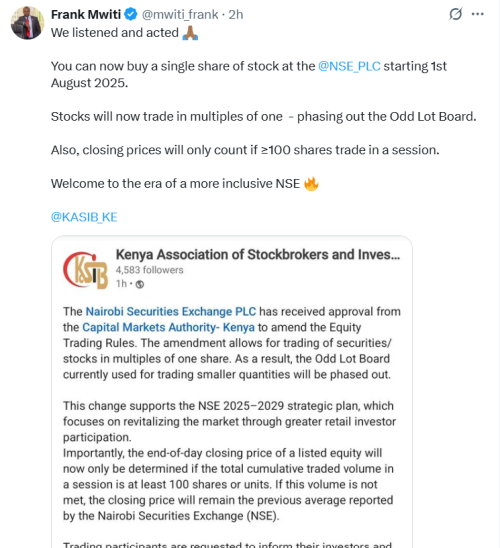
The new policy eliminates the need for this system, aligning with the NSE’s 2025–2029 strategic plan, which focuses on revitalising the market through increased retail participation.
With the removal of the odd-lot system, small-scale investors will now trade alongside institutional players on equal terms.
Market analysts believe this could lead to higher liquidity, improved market depth, and more active trading days as everyday Kenyans take advantage of the simplified process.
New closing price rule introduction
In addition to the single-share trading provision, the NSE has introduced a rule to tighten how closing prices are calculated.
From August 1, a stock’s official end-of-day price will only be recorded if at least 100 shares are traded during the session. If this threshold is not met, the previous day’s closing price will carry over.
According to the NSE, this move is designed to enhance price stability and prevent volatility caused by low-volume trades. The practice also aligns with global stock market standards, where closing prices reflect broader market sentiment rather than isolated transactions.
This reform comes at a time when Kenya’s economy is showing resilience, recording a 5.6% GDP growth in 2024, according to the World Bank.
As digital trading platforms become more accessible, the NSE’s latest decision is expected to draw more young and first-time investors into the stock market, promoting a culture of saving and wealth creation.
Author
Latest News







Advertisement
More on Business