Advertisement
Nairobi Coffee Exchange transitions to shareholding company
Wednesday 11th March, 2026 05:08 PM|

The Nairobi Coffee Exchange is undergoing a major structural change, moving from a private company to a shareholding company. The transition aims to align its operations with regulatory standards.
On Wednesday, March 11 2026, Cabinet Secretary (CS) for Cooperatives and MSMEs Development, Wycliffe Oparanya, met the Nairobi Coffee Exchange Transition Committee to review the final recommendations on the move. The committee presented a comprehensive report detailing the steps necessary for a smooth transition.
Oparanya praised the committee for its diligence and pointed out the importance of transparency and accountability in the sector. He said the transition is crucial to strengthening governance and investor confidence across Kenya’s coffee trade.

“I held a meeting with the Nairobi Coffee Exchange Transition Committee, which presented its final report on the transition of the Nairobi Coffee Exchange (NCE) from a private company to a company limited by shares,” part of Wycliffe Oparanya’s statement on X reads.
You Might Also Like



The CS explained that the shift is part of a strategy to improve the competitiveness and sustainability of Kenya’s coffee sector, ensuring that farmers and stakeholders benefit from a more robust regulatory framework.
“The transition is a key step in aligning the operations and governance of the Exchange with the requirements of the Capital Markets Authority (CMA). It also strengthens transparency, accountability, and investor confidence within Kenya’s coffee trading framework,” Wycliffe Oparanya stated.
Oparanya further commended the committee for their unwavering commitment and the time they invested in compiling the recommendations, noting that their work will guide the Exchange in operating more efficiently and reliably.
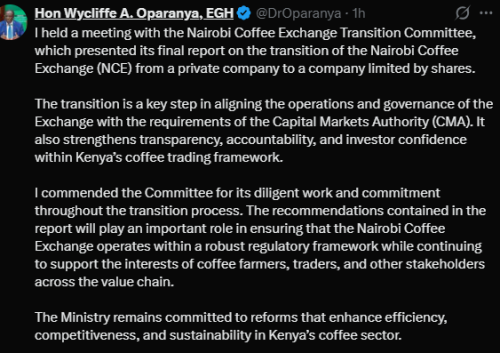
“I commended the Committee for its diligent work and commitment throughout the transition process. The recommendations contained in the report will play an important role in ensuring that the Nairobi Coffee Exchange operates within a robust regulatory framework while continuing to support the interests of coffee farmers, traders, and other stakeholders across the value chain,” Oparanya wrote.
The ministry reaffirmed its commitment to reforms that enhance efficiency and competitiveness in the coffee sector. Oparanya emphasized that the government will continue to support initiatives that improve sustainability, profitability, and market access for farmers.
“The Ministry remains committed to reforms that enhance efficiency, competitiveness, and sustainability in Kenya’s coffee sector,” Oparanya wrote.
Oparanya stated that the move to a shareholding structure will increase transparency, improve governance, and attract more investors, ultimately strengthening Kenya’s position as a leading coffee-producing country in the region.
Author
Latest News








Advertisement
More on Business