MPs urged to tighten oversight and protect small businesses in financial sector bills
By Ndiritu Wanjiru, July 24, 2026Stakeholders have urged the National Assembly’s Departmental Committee on Finance and National Planning to strengthen parliamentary oversight, safeguard consumers and small businesses, and protect data privacy as lawmakers consider three key financial sector reform bills.
The proposals were presented to the committee during public participation at Parliament Buildings on Thursday, July 23, 2026, as members reviewed the Competition (Amendment) Bill, 2026; the Microfinance Bill, 2026; and the East African Development Bank (Amendment) Bill, 2026.
“This committee should not hang Kenyans in broad daylight by conferring diplomatic rights to the EADB. Form a select committee, visit EADB and find out what happens to our money and who enjoys it,” former Kilome MP John Mutinda told the committee.
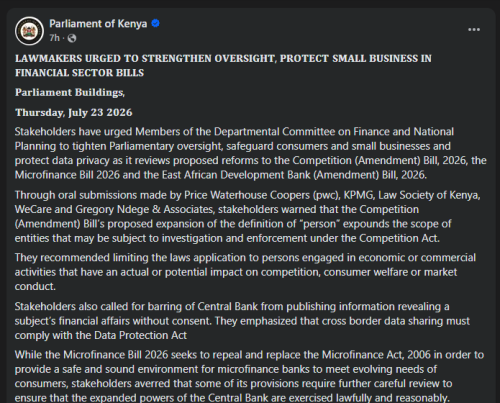
Representatives from PricewaterhouseCoopers (PwC), KPMG, the Law Society of Kenya (LSK), WeCare and Gregory Ndege & Associates cautioned against broad provisions in the proposed Competition (Amendment) Bill.
They argued that the Bill’s expanded definition of a “person” would significantly widen the category of entities that could be investigated or subjected to enforcement under the Competition Act. The stakeholders recommended limiting the law’s application to individuals and entities engaged in economic or commercial activities with an actual or potential impact on competition, consumer welfare or market conduct.
The stakeholders also expressed concern over data privacy, urging lawmakers to bar the Central Bank of Kenya from publishing information that reveals an individual’s financial affairs without consent. They further insisted that any cross-border sharing of financial data must strictly comply with the Data Protection Act.
On the proposed Microfinance Bill, 2026, which seeks to repeal and replace the Microfinance Act, 2006, stakeholders supported the objective of establishing a safer, more responsive regulatory framework for microfinance banks. However, they warned that some provisions granting expanded powers to the Central Bank require further scrutiny to ensure such authority is exercised lawfully, reasonably and within constitutional limits.
Mutinda also proposed significant amendments to the East African Development Bank (Amendment) Bill, 2026. He asked the committee to remove the proposed “deemed approval” provision under Section 2(6) and instead require an affirmative resolution of the National Assembly before any funds are disbursed to the regional lender.
Calls for audit
Additionally, he called for changes to Section 2(3) to require independent audits of all money disbursed to the East African Development Bank, arguing that relying solely on reports from the Cabinet Secretary would not provide sufficient accountability.
His submissions prompted questions from the committee’s sessional chairperson, Kitui Rural MP David Mboni Mwalika, who challenged the former ambassador to explain what action he took on the issue while serving as Kenya’s envoy to Tanzania.
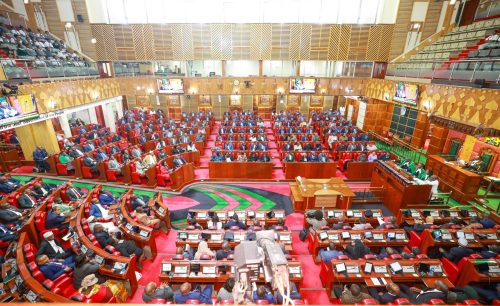
“You were an Ambassador of Kenya to the Republic of Tanzania. What did you do regarding the EADB, and how come Kenya isn’t doing better?” Mwalika asked.
In response, Dr Mutinda maintained that the East African Development Bank operated effectively between 1980 and 2009 but argued that accountability diminished after the institution was granted diplomatic immunity, making it no longer answerable to the National Assembly. He urged MPs to review the bank’s current governance and reporting structure to enhance oversight.
The Finance and National Planning Committee thanked the stakeholders for their submissions, noting that the recommendations would help refine the three bills by strengthening market regulation, improving consumer protection, promoting financial stability, enhancing public accountability and ensuring regulatory certainty without imposing unintended burdens on businesses, consumers and regulated institutions.