Mbadi signals possible budget cuts as growth slows, debt pressure tightens
By Kenneth Mwenda, May 25, 2026The National Treasury has signalled that Kenya may have to revise or cut the 2026/27 budget if economic growth continues to slow, saying rising pressure on revenues and rigid spending commitments have left little fiscal space.
Speaking to journalists on Monday, May 25, 2026, Treasury Cabinet Secretary John Mbadi said the government is still assessing the economic outlook but admitted that downward revisions are already being considered.
“We are monitoring the situation as it is, but obviously it’s going to hit all economies. All economies are revising their projections downwards in terms of economic growth. Even Kenya, we are already lowering it,” Mbadi said.
He added that the current growth assumption of about 5 per cent may not hold, pending technical confirmation from his team.
“Let my team work on it. I don’t want to interfere with my technical team. Let them present to me the facts and we will communicate,” he said.
The Treasury is working on a proposed Ksh.4.82 trillion budget for the 2026/27 financial year. According to official estimates, the government expects to raise Ksh.3.63 trillion in revenue, leaving a financing gap of about Ksh.1.1 trillion.
Mbadi said any drop in growth would directly reduce revenue and force hard choices.
“The moment the projected economic growth comes down, revenue projection will come down. And if revenue is down, how do you finance the same budget? Either by borrowing or taxation,” he said.
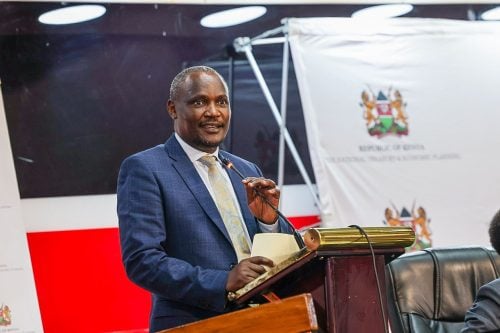
Treasury faces fiscal strain
He ruled out both options for now.
“We have no option to come for more taxes. Borrowing is another no-go zone,” he said, pointing to the already high debt burden.
The CS said this leaves spending cuts as the only realistic adjustment, though he stressed that no decision has been made.
“So what is the other option left? Cut the budget. So, however painful it is, we may go that route,” he said. “But for now, it is too early to say that because we must be sure of the magnitude.”
Mbadi described the budget as highly rigid, with most spending already locked in. He broke down how the proposed Ksh.3.63 trillion in revenue is already committed.
Debt servicing alone takes about Ksh1.5 trillion, leaving roughly Ksh2.1 trillion. From this, salaries consume a large share, followed by county allocations of about Ksh420 billion and Constituency Development Fund allocations of Ksh61 billion.
Social spending also takes significant amounts, including cash transfers for the elderly (Ksh25 billion), capitation for secondary schools (Ksh54 billion), junior secondary schools (Ksh31 billion), and primary schools (Ksh7 billion). Other fixed costs include fertilizer subsidies, emergency health funds, and security spending.
“The entire budget for security, including salaries, is about Ksh.566 billion,” he said. “Where is the money? Where do you even cut?”
He said such fixed obligations leave little room for adjustment once debt repayment and salaries are factored in.
“This budget is so rigid. It is inflexible. We have boxed ourselves,” Mbadi said.
The CS also defended government efforts to stabilise the shilling, warning against policy shifts that could worsen debt servicing costs.
“We are praying and working hard that the shilling remains stable,” he said. “If it depreciates, the cost of servicing debt goes up.”
He criticised calls to abandon government-to-government oil import arrangements, saying such moves could destabilise the currency.
“Those calling for discontinuation of G2G want this economy to commit suicide. We will not allow it,” he said.
Mbadi acknowledged Kenya is not yet out of fiscal risk despite avoiding default pressure.
“We have come out of an almost very unfortunate situation of debt default, but we are not off the hook yet,” he said.