Advertisement
Mbadi defends proposed withholding tax on Visa card transactions
Monday 25th May, 2026 01:09 PM|

Treasury Cabinet Secretary John Mbadi has defended the proposed introduction of withholding tax on card transactions under the Finance Bill 2026, saying the move is intended to seal existing legal gaps in taxation and strengthen government revenue collection from digital financial services.
Speaking during a press conference on Monday, May 25, 2026, Mbadi said the proposal targets fees linked to card payment systems such as Visa card interchange charges and payments made by banks to international card companies, which he noted are currently not properly classified under Kenya’s tax framework.
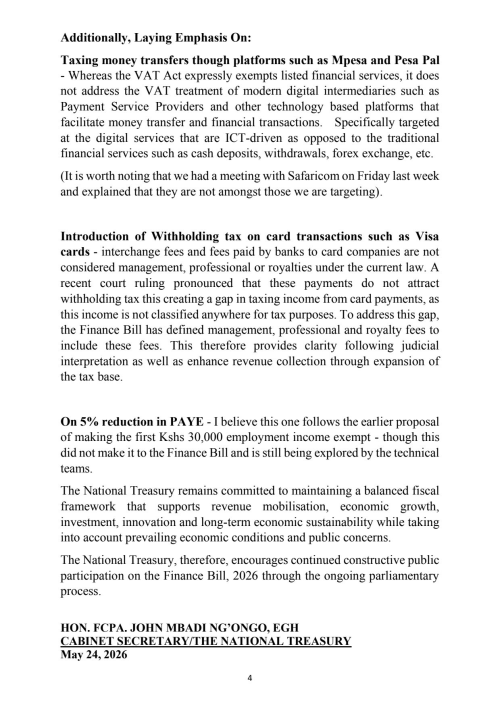
The Treasury CS explained that a recent court ruling determined that such fees do not qualify as management, professional or royalty payments under the existing law, meaning they do not attract withholding tax despite generating significant income within the digital payments ecosystem.
Treasury seeks to close tax loopholes
Mbadi said the Finance Bill 2026 now seeks to formally redefine management, professional, and royalty fees to include payments associated with card transaction services in order to eliminate ambiguity created by judicial interpretation.
You Might Also Like



“This therefore provides clarity following judicial interpretation as well as enhances revenue collection through expansion of the tax base,” Mbadi stated.

He maintained that the proposal is part of broader government efforts to modernise tax laws in response to changing financial and technological systems, especially as digital transactions continue growing rapidly across the country.
Debate over digital taxation grows
The proposed changes have already triggered debate among financial sector players and digital economy stakeholders, with critics warning that additional taxation on digital financial services could eventually increase transaction costs for consumers and businesses.
Some analysts argue that Kenya’s fast-growing cashless economy depends heavily on affordable digital payment systems, and any additional levies could affect online businesses, e-commerce, and financial inclusion.
However, Treasury officials insist the measures are necessary to broaden the tax base and ensure all sectors contribute fairly to national revenue collection.
Finance Bill scrutiny intensifies
The latest proposal adds to mounting public scrutiny surrounding the Finance Bill 2026, which has generated intense discussion over taxes affecting mobile phones, digital platforms, and financial technology services.

Parliament is expected to begin debate on the Bill in the coming weeks before lawmakers vote on whether to approve it for presentation to President William Ruto for assent.
Economic analysts predict heated parliamentary discussions as concerns grow over balancing revenue generation with protecting Kenya’s expanding digital economy.
Author
Latest News








Advertisement
More on Business