Advertisement
Lee Kinyanjui welcomes lifting of PPA moratorium as boost for Kenya’s investment climate
Thursday 13th November, 2025 02:54 PM|

Cabinet Secretary for Investments, Trade and Industry, Lee Kinyanjui, has applauded the decision to lift the moratorium on Power Purchase Agreements (PPAs), describing it as a crucial milestone for Kenya’s economic and energy transformation.
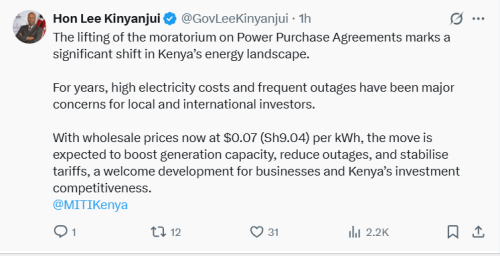
“The lifting of the moratorium on Power Purchase Agreements marks a significant shift in Kenya’s energy landscape,” Kinyanjui said in a post on X dated November 13, 2025. “For years, high electricity costs and frequent outages have been major concerns for local and international investors,” he added.
“With wholesale prices now at $0.07 (Sh9.04) per kWh, the move is expected to boost generation capacity, reduce outages, and stabilise tariffs, a welcome development for businesses and Kenya’s investment competitiveness,” he further noted.
The announcement follows Parliament’s approval on November 12, 2025, to end the seven-year freeze on new PPAs, a move expected to unlock stalled energy projects.
You Might Also Like
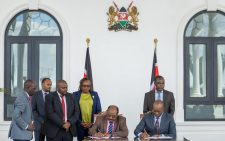

Lawmakers voted by acclamation to adopt the Energy Committee’s recommendation to lift the ban, which has been in place since 2018.
New framework
Kenya has faced mounting electricity supply challenges over the past few years, with the freeze forcing the country to rely on imports from Ethiopia and Uganda to bridge supply gaps. Kenya Power has, however, not entered into any new agreements since 2018, when a presidential task force called for a suspension to review costly deals with independent power producers.
The halt slowed the expansion of local generation capacity, increasing dependence on imported electricity and contributing to recurrent power rationing. “As leaders, we have a responsibility to adopt this addendum. As we promised the private sector, we are now addressing the matter,” Majority Leader Kimani Ichung’wah stated.
Under the new arrangement, Parliament has introduced stricter terms for upcoming contracts, including capping the wholesale power price at $0.07 (Sh9.04) per kWh and allowing agreements to be priced in either shillings or dollars. The pricing limit is aimed at containing costs for consumers while easing the financial burden on industries and households.
Rising demand
Although the Cabinet had lifted the moratorium in 2023, legislators reinstated it to allow further scrutiny of existing contracts. Kenya Power has since struggled to meet the growing demand, with electricity rationing reported in parts of western Kenya.
The share of imported electricity rose to 10.6 percent, equivalent to 1.53 billion kilowatt-hours (kWh) in the year ending June 2025, compared to 4.87 percent in 2024 and one percent in 2021. Despite increased imports, outages persist, with President William Ruto recently acknowledging that power cuts between 5pm and 10pm have become frequent in some areas due to limited supply.
Electricity demand surged by 243 megawatts between 2022 and August 2025, while local production grew marginally during the PPA freeze. The 2018 suspension was triggered by concerns over expensive contracts, an issue lawmakers believe will now be addressed through the new pricing ceiling.
Author
Latest News





Advertisement
More on Business