KNCCI slams govt over diesel price hike amid falling global crude costs
By Aloys Michael, May 15, 2026The Kenya National Chamber of Commerce and Industry (KNCCI) has criticised the government over the latest diesel price hike, arguing that domestic taxes and levies are driving fuel costs higher even as global crude oil prices ease.
In a statement on Friday, May 15, 2026, KNCCI said the increase in diesel prices was disproportionately high compared to movements in the international oil market.
“While global crude oil prices increased by approximately 10.7 per cent during the April–May review period, Kenya’s diesel prices rose by 23.5 per cent over the same cycle. This points to the continued role of domestic cost buildup, including taxes, levies, exchange-rate effects, margins and landed product costs,” the X statement read in part.
The Chamber termed the latest increase of Ksh46.29 per litre, pushing diesel prices to Ksh242.92, as alarming, noting that diesel remains critical to transport, agriculture, manufacturing, logistics, construction and trade.
KNCCI warned that Kenya continues to rank among the most expensive fuel markets in East Africa, undermining the country’s competitiveness against neighbouring economies.
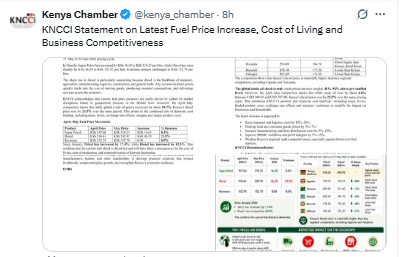
According to comparative regional pricing released by the Chamber, Kenya’s diesel price of Ksh242.92 per litre is significantly higher than Uganda’s Ksh174.37, Tanzania’s Ksh211.40, Burundi’s Ksh175.20 and Ethiopia’s Ksh176.30.
“The comparison shows that Kenya’s diesel price is materially higher than key regional competitors, including Uganda and Tanzania,” the chamber stated.
It argued that although geopolitical tensions in the Middle East continue to exert pressure on global oil markets, domestic taxes, levies, exchange rate pressures and other local charges are worsening the burden on businesses and households.
KNCCI further cautioned that the widening fuel cost gap could weaken Kenya’s position as a regional logistics, manufacturing and trade hub.
Moreover, the business lobby urged the government to review and rationalise fuel taxes and levies, particularly on diesel, while enhancing transparency in fuel pricing by publishing clearer cost build-ups during every EPRA review cycle.
It also called for accelerated investment in local refining capacity and stronger energy trade partnerships with African oil-producing countries to reduce dependence on expensive imported refined fuel.

Wandayi on fuel hike
Meanwhile, the Energy and Petroleum Cabinet Secretary Opiyo Wandayi defended the latest fuel price review, saying the government had implemented measures to cushion consumers from the full impact of rising global fuel costs.
Wandayi said the increase in pump prices for super petrol and diesel was driven by instability in global oil markets caused by ongoing geopolitical tensions in the Middle East.
“The continued geopolitical tensions in the region have disrupted global energy markets, leading to a sharp increase in international crude oil prices and elevated freight and supply chain costs,” Wandayi stated.
According to the CS, the landed cost of imported super petrol rose from Ksh106,242.99 per cubic metre in March 2026 to Ksh116,948.98 in April 2026, representing a 10 per cent increase.
Diesel’s landed cost also increased sharply by 20.32 per cent from Ksh138,576.47 per cubic metre to Ksh166,730.02 over the same period.
Wandayi said the government had applied Ksh5 billion during the current review period to moderate price increases for diesel and kerosene while ensuring stability in the petroleum supply chain.
He added that kerosene prices had been maintained at current levels through targeted support measures aimed at protecting vulnerable households that rely on the fuel for domestic use.