Advertisement
KNBS: Most Kenyans receiving diaspora money have no investments
Wednesday 17th June, 2026 08:22 AM|

Kenyan households are receiving hundreds of billions of shillings from relatives living abroad, but very little of the money is finding its way into investments, raising concerns about missed opportunities for long-term wealth creation.
A new survey by the Kenya National Bureau of Statistics (KNBS) shows that while households received an estimated Ksh931.8 billion in remittances between June 2024 and May 2025, most of the funds were spent on immediate needs such as food, education and healthcare rather than savings or investment.
The findings, contained in the 2025 Remittances Household Survey, reveal that diaspora money has become a lifeline for household consumption but has had limited impact in building assets or expanding investment portfolios among recipient families.
“The findings showed that remittances were predominantly used to support household consumption, serving as a critical buffer against economic vulnerability and helping households meet essential day-to-day requirements,” the report says.
You Might Also Like


According to KNBS, 73.1 per cent of recipient households used remittances to buy food and household goods, making it the most common use of the funds.
Another 31.4 per cent spent the money on education-related expenses, while 23.9 per cent used it to cover medical bills.
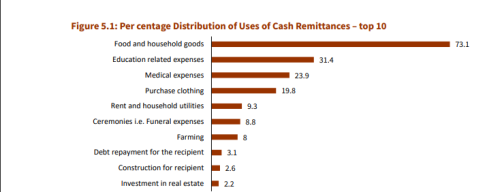
In contrast, investment-related activities accounted for only a small fraction of remittance spending. Just 2.2 per cent of households used remittances for real estate investment, while 2.6 per cent directed the funds towards construction projects.
The report notes that uptake of formal financial and investment products among remittance-receiving households remains low despite the substantial inflows.
“Allocation of remittances to savings, formal investments and financial instruments was limited, indicating untapped potential for leveraging remittances for wealth creation and financial deepening,” KNBS states.
The findings challenge a common perception that diaspora money is primarily used to build homes, buy land or establish businesses.
Instead, the KNBS said households are relying on remittances to meet basic needs amid persistent economic pressures and rising living costs.
The survey comes at a time when Kenya is increasingly looking to the diaspora as a key source of foreign exchange and economic growth.
Remittance inflows have consistently outperformed several traditional foreign currency earners, including some export sectors and development assistance programmes.
Yet the report suggests that the developmental impact of remittances may be constrained if most households remain trapped in consumption cycles.
The findings also raise questions about whether existing financial products are adequately designed to help diaspora recipients save and invest.
Author
Latest News







Advertisement
More on Business