KEPSA warns Finance Bill 2026 risks job losses and investor exit
By Aloys Michael, May 25, 2026The Kenya Private Sector Alliance (KEPSA) has pushed against parts of the Finance Bill 2026, warning that some of the proposed tax measures could choke businesses, weaken Kenya’s competitiveness and slow job creation.
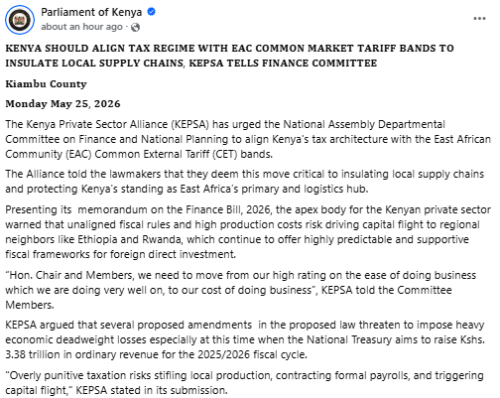
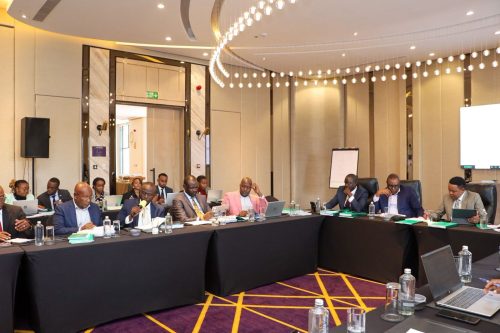
Appearing on Monday, before the National Assembly Departmental Committee on Finance and National Planning, KEPSA leaders told Parliament to amend the Bill, saying the country’s tax policies should support industrial growth and economic expansion instead of piling pressure on struggling businesses and workers.
The lobby group’s chairperson, Jaswinder Bedi, said the private sector supports caution against overtaxing the formal economy.
“We fully support the government’s agenda, but structural economic stability demands an intentional balance between aggressive domestic revenue mobilisation and the preservation of private sector competitiveness,” Bedi said.
He warned that Kenya risks losing investments to countries such as Rwanda and Ethiopia if the tax environment remains unpredictable and expensive.
“If we are not competitive as an economy, we will find ourselves in a very difficult place. It is time we looked at our global competitiveness and not just local or regional competitiveness,” he said.
KEPSA noted that the formal sector currently accounts for only 16.2 per cent of jobs, equivalent to about 3.5 million workers, while the informal sector employs 18.1 million people.
Tax bane
According to the alliance, increasing taxes on the shrinking formal sector would only deepen the burden on compliant taxpayers instead of expanding the tax base.
“True revenue growth is a by-product of an expanding economic base, not intensifying tax rates on a shrinking pool of formal taxpayers,” Bedi said.
Among the key proposals tabled by the private sector is a reduction of the top Pay As You Earn (PAYE) tax rate from 35 per cent to 30 per cent, alongside increasing personal tax relief to Ksh3,000.

KEPSA and the Kenya Bankers Association (KBA) argued that lowering PAYE would leave workers with more disposable income, stimulate spending and ultimately expand government revenue through economic activity.
KBA chief executive Raimond Molenje said reducing PAYE by five percentage points across all tax bands could free up about Ksh28.1 billion for workers and businesses.
Molenje said the move could grow the economy by up to Ksh210 billion within the first year and create around 36,000 jobs.
“What we are pushing for is consumption-led growth because it has a much bigger multiplier effect than the current taxation regime,” he said.
The private sector also opposed proposals to remove VAT exemptions on money transfer and financial services, warning that imposing 16 per cent VAT on digital payment processing would raise transaction costs and undermine financial inclusion.
VAT tax cut
Bedi said the move could reverse gains made in Kenya’s digital economy and push traders back to cash transactions.
“Taxing digital processing triggers a cascading tax effect that increases transaction costs and the cost of doing business,” he said.
KEPSA further criticised plans to remove VAT exemptions on electric motorcycles, bicycles and lithium-ion batteries, saying the measures contradict Kenya’s green economy ambitions.
The alliance also opposed new taxes on aircraft and aircraft parts, warning that aviation-related businesses could relocate to rival regional hubs.
“Subjecting specialised aviation equipment to additional levies will drive fleet technical services and cargo consolidation out of Kenya to regional competitors,” Bedi said.
The Pharmaceutical Society of Kenya (PSK) also called for retention of zero-rated taxes on pharmaceutical raw materials and essential medicines.
Society president Wairimu Mbogo warned that shifting pharmaceutical inputs from zero-rated to tax-exempt status would increase production costs and push up medicine prices.
“We need to move towards a point where we are locally manufacturing for health equity,” Mbogo said.
She added that lower taxes on pharmaceutical inputs could reduce medicine prices by up to 10 per cent while strengthening local manufacturing.
Exporters, including the Kenya Flower Council (KFC) backed proposals to reduce VAT on agricultural inputs from 16 per cent to eight per cent to ease cash flow pressures.

KEPSA also rejected proposals allowing the Kenya Revenue Authority to freeze bank accounts and issue agency notices while tax disputes are still in court.
The alliance argued that removing taxpayer protections under the Tax Procedures Act would violate constitutional rights to fair hearing and fair administrative action.
“Freezing accounts mid-litigation forcefully drains corporate liquidity before a court can rule on the case’s merit,” Bedi said.
The business lobby now wants MPs to revise the Finance Bill to promote industrialisation, job creation and investor confidence.
“Parliament must ensure that the Finance Bill 2026 acts as a catalyst for industrialisation and job creation, not an insurmountable barrier to entry,” Bedi said.