Advertisement
Bankers Association wants PAYE slashed by 5% to ease cost of living pressure
Monday 25th May, 2026 02:32 PM|

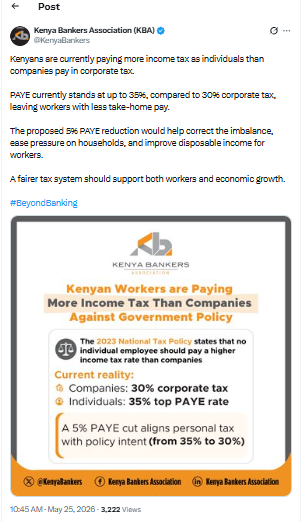
Kenya Bankers Association has sparked debate after sharing concerns over the current tax burden on Kenyan workers, arguing that salaried employees are paying higher income tax rates than companies, leaving many households under increasing financial pressure.
In a post shared on its official X account on Monday, May 25, 2026, the Kenya Bankers Association noted that PAYE currently stands at up to 35 per cent compared to the 30 per cent corporate tax paid by companies, a gap that critics say continues to reduce workers’ take-home pay amid rising living costs.
Calls for PAYE reduction
The association backed proposals for a 5 per cent reduction in PAYE, saying the move would help correct the imbalance, ease pressure on households and improve disposable income for Kenyan workers struggling with the high cost of living.
“The proposed 5% PAYE reduction would help correct the imbalance, ease pressure on households, and improve disposable income for workers,” the statement read.
You Might Also Like



KBA further argued that a fair taxation system should support both employees and economic growth rather than overburden salaried workers at a time of economic uncertainty.
“A fairer tax system should support both workers and economic growth,” the association added.
Economic pressure mounting
The remarks come as Kenyans continue grappling with rising food prices, transport costs, and expensive credit, factors that analysts say have significantly weakened household purchasing power.
The tax debate also emerges against the backdrop of broader concerns within the financial sector over Kenya’s economic outlook, with commercial banks recently urging the Central Bank of Kenya to maintain the benchmark lending rate at 8.75 per cent due to growing global uncertainty and inflationary risks.
Bankers have warned that external shocks, including geopolitical tensions and rising oil prices, continue to pose serious risks to economic stability and household incomes.
Debate on tax fairness grows
Economic observers say the discussion around PAYE is likely to intensify as pressure grows on the government to balance revenue collection with protecting workers from excessive taxation.
Analysts argue that lowering PAYE could increase disposable income, stimulate consumer spending, and help support economic recovery at a time when many families are struggling with shrinking earnings and rising daily expenses.
Author
Latest News







Advertisement
More on Business