Kenya’s consumer prices rise modestly in September 2025
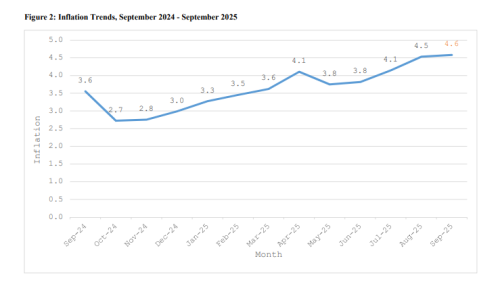
By Kenneth Mwenda, September 30, 2025Kenya’s annual inflation rate reached 4.6 per cent in September 2025, according to the latest Consumer Price Index (CPI) report from the Kenya National Bureau of Statistics (KNBS).
This means that, on average, prices for a typical basket of goods and services were 4.6 per cent higher than in September 2024.
Officials released the data on September 30, 2025, noting that food costs contributed significantly to the increase, though overall inflation remained relatively stable compared with recent months.
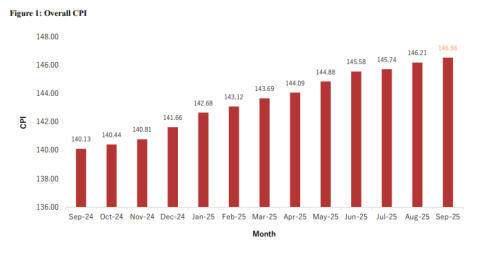
The overall CPI rose from 146.21 in August to 146.56 in September, pushing monthly inflation up by 0.2 per cent. This marked a slight slowdown from August’s 0.3 per cent monthly increase.
Over the past year, inflation has moved between 2.7 per cent in October 2024 and the current 4.6 per cent, peaking at 4.5 per cent in August before easing slightly. These trends reflect a gradual economic recovery, even as global supply chain pressures continue to affect prices.
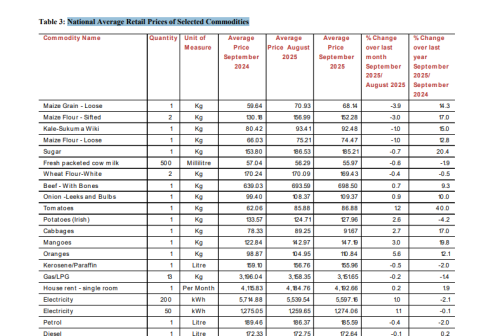
Food and non-alcoholic beverages led the rise, with an 8.4 per cent annual increase. This category carries 33 per cent of the CPI weight, so its impact on overall inflation is substantial. Among individual items, prices for oranges rose 5.6 per cent, mangoes 3.0 per cent, cabbages 2.7 per cent, potatoes 2.6 per cent, and tomatoes 1.2 per cent.
At the same time, some staples fell in price. Maize grain dropped 3.9 per cent to Ksh68.14 per kg, sifted maize flour 3.0 per cent to Ksh152.28 for 2 kg, and kale 1.0 per cent to Ksh92.48 per kg. Sugar also fell 0.7 per cent to Ksh185.21 per kg. These mixed movements reflect seasonal harvests easing prices for some items, while others face drought-related pressures.
Rising costs across sectors
Transport costs rose 4.0 per cent annually, though monthly prices fell by 0.3 per cent. Petrol declined 0.4 per cent to Ksh185.59 per litre, diesel 0.1 per cent to Ksh172.64, and bus fares 0.5 per cent. However, car batteries increased 1.4 per cent, and rentals edged up 0.4 per cent.
Housing, water, electricity, gas, and fuels rose 1.4 per cent over the year, with charcoal surging 3.4 per cent monthly, electricity for 200 kWh increasing 1.0 per cent to Ksh5,597, and single-room rent rising 0.2 per cent to Ksh4,193. Gas/LPG and kerosene recorded small declines of 0.2 per cent and 0.5 per cent respectively.
Other categories recorded smaller gains. Alcoholic beverages, tobacco, and narcotics rose 3.3 per cent, while clothing and footwear also increased 3.3 per cent. Health climbed 3.0 per cent, led by spectacles and antacids.
Furnishings rose 2.0 per cent, recreation 2.8 per cent, education 2.2 per cent, restaurants 2.6 per cent, and personal care 3.1 per cent. Information and insurance remained low at 0.8 per cent each.
Core inflation contributed 2.8 points, while non-core inflation contributed 1.7 points to the overall inflation in August 2025. Food and nonalcoholic beverages contributed to 2.7 points to the overall inflation.