Advertisement
Inside Ruto’s mega projects funding crisis as KNBS data exposes widening budget strain
Friday 01st May, 2026 11:48 PM|

President William Ruto’s flagship development agenda, anchored on mega projects such as affordable housing and universal health coverage, is facing mounting financial pressure, with new data from the Kenya National Bureau of Statistics (KNBS) painting a picture of a government stretched between ambition and fiscal reality.
The Economic Survey 2026 reveals a widening gap between government revenue and expenditure, showing the structural constraints now threatening the pace and sustainability of key programmes.
According to KNBS, the National Government expects to spend Ksh4.27 trillion in the 2025/26 financial year against revenues of Ksh3.38 trillion, leaving a significant financing deficit. This imbalance indicates the growing difficulty of funding large-scale projects without increased borrowing or cuts elsewhere.
At the same time, Kenya’s public debt has surged to Ksh11.4 trillion, with debt servicing consuming an increasingly large share of public resources. Interest payments alone stand at Ksh851 billion, crowding out development spending and limiting fiscal flexibility.
You Might Also Like

The pressure is already evident in the Affordable Housing Programme (AHP), one of Ruto’s signature pledges. While the construction sector remains a key economic driver, supported largely by government-backed housing initiatives, KNBS data shows fluctuating public investment.
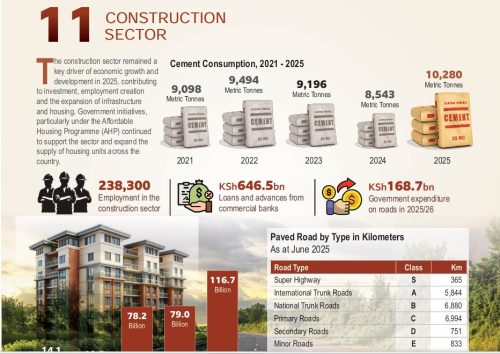
Government expenditure on housing dropped to Ksh79.0 billion in 2025/26, down from a peak of Ksh116.7 billion in 2024/25, reflecting tightening fiscal space.
This comes days after Housing Principal Secretary Charles Hinga disclosed that donor funding for the programme has been cut by Ksh800 million, reducing allocations from Ksh13.3 billion to Ksh12.5 billion in the current supplementary budget.
Currently, we have 1,700 ongoing housing projects. We also have a personnel shortage; some officers are working up to three shifts due to understaffing,” Hinga told Parliament.
He warned that funding constraints are already biting, noting that 80 per cent of the allocated budget has been utilised, with limited room to sustain momentum.
“The department had anticipated the funding inadequacy, although the Department had saved some funds in Treasury Bills, the National Treasury has declined to allow access,” he added.
The implications are significant: delays in project completion, rising costs due to inflation and financing gaps, and potential job losses in a sector that employs over 238,000 people, according to KNBS.
SHA rollout faces fiscal pressure
The Social Health Authority (SHA), central to Kenya’s Universal Health Coverage (UHC) ambitions, is also operating within a constrained fiscal environment.
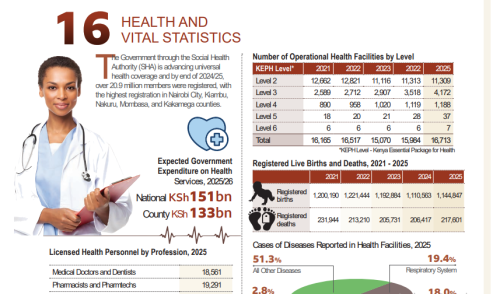
KNBS reports that government health expenditure is projected at Ksh 151 billion at the national level and Ksh133 billion at the county level in 2025/26. While this reflects continued prioritisation, the broader fiscal squeeze raises questions about long-term sustainability.
Already, SHA has registered over 20.9 million members, signalling rapid scale-up.
However, maintaining service delivery, expanding infrastructure, and clearing pending bills will require consistent funding, something increasingly uncertain amid budgetary pressures.
The funding crisis comes despite Kenya posting moderate economic growth. KNBS data shows GDP expanded by 4.6 per cent in 2025, supported by broad-based sector performance.
But this growth has not translated into sufficient revenue to match rising expenditure demands. Government spending has climbed to 24.3 per cent of GDP, while revenue stands at 19.0 per cent of GDP, leaving a persistent deficit.
In addition, external pressures, including a widening current account deficit of Ksh373.3 billion and high import costs, are compounding fiscal challenges.
The KNBS report suggests that Kenya’s development model, heavily reliant on public spending and debt-financed infrastructure, is hitting structural limits.
With 79 per cent of government revenue coming from taxes and only 1 per cent from grants, the country has limited alternative financing options. Meanwhile, donor support appears to be tightening, as evidenced by cuts to housing programme funding.
For the Ruto administration, this creates a delicate balancing act: pushing ahead with politically critical mega projects while maintaining fiscal discipline and avoiding unsustainable debt accumulation.
The emerging funding crunch raises critical questions about the future of Kenya’s flagship programmes. Without new revenue streams, improved efficiency, or increased private sector participation, delays and scaling back of projects such as affordable housing and SHA may become inevitable.
As the KNBS data makes clear, the challenge is no longer just about launching ambitious projects, but sustaining them in an era of tightening public finances.
Author
Latest News


Advertisement
More on Business