Inside Kenya’s push to meet new global labour market demands
By Elijah Cherutich, December 5, 2025Trade and Industry Cabinet Secretary Lee Kinyajui has revealed that the country is preparing to apply the samurai bond in the enhancement of industrial training institutions to produce quality-skilled personnel to meet the labour market’s demand.
A Samurai bond is a yen-denominated bond issued in Japan by a non-Japanese entity (company, government, or organisation) and sold to Japanese investors, allowing foreign borrowers to tap into Japan’s deep capital markets for funding, often at competitive rates, while subject to Japanese regulations and offering investors yen-denominated, familiar investments.
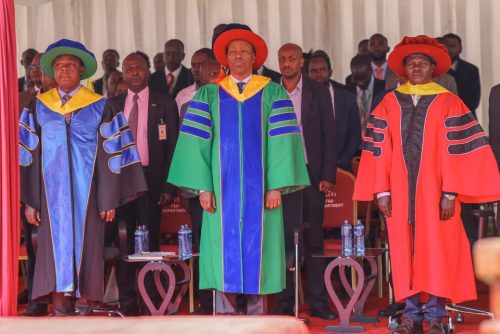
Speaking on Friday, December 5, 2025, at Kenya Industrial Training Institute in Nakuru during the graduation ceremony, CS Kinyanjui said that the focus of the country to step into the capabilities of first world status should be a heavy focus on sciences and technical education to meet the skills needed.
“Kenya is working together with the Japanese government on a Samurai bond of about Ksh23 billion to upgrade institutions like this and equip them to give a face that can churn out skilled individuals to drive the country to the next level”, he said.
The CS that giant countries, including China, have heavily invested in the engineering fields, as well as the technical skills to ensure that production is not limited by insufficient human capital.
Upskilling
Kinyanjui said that with the massive construction in the housing sector, major highways and other infrastructure, there is a need for skilled personnel to handle the demand, and as such, they are looking at the institutions to provide the same to transition the country to that front.

“The way to address youth unemployment is to create work at home, which is where we are talking of creating manufacturing at home, growing food and having surplus, and that is why globally, our target is to open markets. Even as we open the markets, so must business people follow us with the products,” he said.
Moreover, he said the ministry is also doing some assessment of the curriculum reform to ensure that those who come out of the institutions can be able to work around the world, even in places where there are some language challenges.
He reiterated that the positioning of the country and strategic networks is critical towards addressing the overall goal of growing the economy to meet the current expectations.