Advertisement
How the Finance Bill 2026 could shrink your salary without touching PAYE
Friday 29th May, 2026 11:19 PM|

Kenyan workers could soon feel a deeper squeeze on their salaries even without an increase in Pay As You Earn (PAYE) tax if the Finance Bill 2026 sails through Parliament.
While the National Treasury insists the bill introduces no new taxes, there is uproar from lobby groups warning that expanded taxation on digital transactions, tighter compliance measures and indirect cost pressures could quietly reduce disposable income for millions of salaried Kenyans.
The debate comes even as Treasury Cabinet Secretary John Mbadi defends the government’s proposed personal income tax reforms amid mounting criticism over the absence of immediate PAYE relief measures for workers.
Speaking during a press briefing on Monday, May 11, 2026, Mbadi said the government was still considering amendments that would cushion low-income earners from high PAYE deductions.
You Might Also Like


“We wanted the personal income tax base to increase, and then that would help us compensate for the loss in this Pay As You Earn,” Mbadi said.
He added that discussions with President William Ruto had informed the decision to push for possible amendments to the bill rather than waiting for separate tax legislation later in the year.
“We have agreed with the Head of State that this is an amendment that we carry, even regardless of our revenue, because we feel it is important for the economy,” Mbadi stated.
However, the proposals have triggered widespread concern among workers who expected immediate tax relief, particularly after earlier promises that Kenyans earning below Ksh30,000 monthly would be exempted from PAYE.
Former Law Society of Kenya (LSK) President Faith Odhiambo criticised the omission, saying salaried Kenyans had been led to expect relief measures.

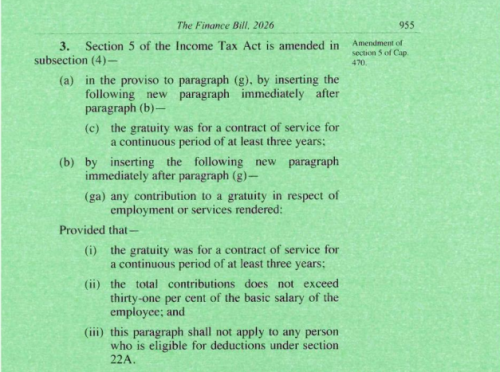
“On PAYE, Kenyans were led to expect relief and a restructuring of the tax bands to ease the burden on salaried workers. That proposal does not appear in this Bill,” Odhiambo said.
“That is not a minor omission. An explanation is owed to every employed Kenyan who was waiting for it.”
Although PAYE rates remain unchanged in the bill, financial analysts say workers could still lose purchasing power through indirect taxation and rising transaction costs.

The hidden taxes
One of the most controversial proposals is the expansion of the definition of royalty under the Income Tax Act to include digital payment systems.
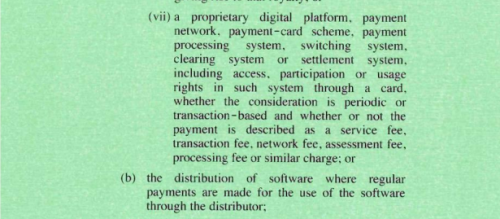
“A proprietary digital platform, payment network, payment-card scheme, payment processing system, switching system, clearing system or settlement system,” the bill reads.
“Whether the consideration is periodic or transaction-based and whether or not the payment is described as a service fee, transaction fee, network fee, assessment fee, processing fee or similar charge.”
The proposal could increase operational costs for banks, fintech firms and payment processors, which may ultimately pass the burden to consumers through higher transaction charges.
For salaried workers who rely heavily on mobile money, online banking and card payments, the changes could quietly erode take-home income through higher daily expenses.
Economists warn that businesses affected by increased compliance and tax obligations are also likely to transfer costs to consumers through higher prices on goods and services, worsening inflationary pressure.
The Finance Bill 2026 additionally tightens tax compliance timelines.
Under the proposed amendments, taxpayers will now be required to file returns by the last day of the fourth month following the end of the person’s year of income, while nil returns must be filed within one month following the end of the year of income.”
Stricter filing timelines could expose more workers and small businesses to penalties, especially freelancers and side-hustle operators already struggling with multiple statutory deductions.
Mbadi defended the government’s broader strategy, arguing that expanding the tax base was necessary to maintain revenues amid global economic uncertainty.
“We are looking at the impact of that war already. We have reduced VAT on petroleum products. We don’t know for how long, so that is something we must factor into our revenue projections,” he said.
Still, critics argue that ordinary Kenyans are less concerned about whether the measures are labelled as taxes and more worried about their shrinking spending power.
Author
Latest News




Advertisement
More on Business