Advertisement
Developing nations are losing ksh64.5 trillion a year to expensive debt – UNCTAD
Saturday 20th June, 2026 12:26 AM|

Developing countries are forfeiting nearly Ksh64.5 trillion every year because they face significantly higher borrowing costs than advanced economies, according to a new report by the United Nations Conference on Trade and Development (UNCTAD).
The agency says the steep cost of debt is draining public resources that could otherwise be invested in critical sectors such as healthcare, education and clean energy, slowing progress towards the Sustainable Development Goals (SDGs).
UNCTAD estimates that developing countries could save close to Ksh64.5 trillion annually if they were able to access financing on the same terms as developed nations.
While many developing economies have strengthened domestic financing over the past decade, access to international capital has become more limited and expensive.
You Might Also Like



The report shows that between 2014 and 2024, gross capital formation in developing countries grew by 45 per cent, while domestic financing increased by 60 per cent. Over the same period, however, new external financial inflows from non-residents declined by 18 per cent.
“External financing has also become a less important source of investment funding. In 2024, only 11 per cent of gross capital formation in developing countries was financed by non-resident sources, down from 20 per cent a decade earlier,” the report shows.
Developed economies, by contrast, received external financing equivalent to 38 per cent of their investment needs.
Interest costs rising faster than revenues
The report identifies mounting debt-servicing obligations as one of the biggest threats to economic development.
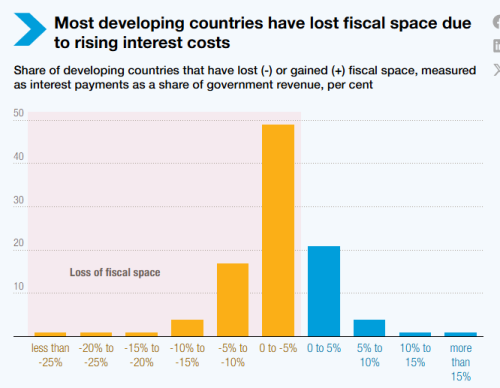
Between 2014 and 2024, government interest payments across developing countries surged by 102 per cent, while government revenues rose by just 39 per cent.
According to UNCTAD, interest payments increased 2.6 times faster than revenues, highlighting growing pressure on public finances.
As a consequence, 73 per cent of developing countries saw their fiscal space shrink between 2018 and 2024, limiting governments’ capacity to finance development programmes.
In 2024, interest costs on external public and publicly guaranteed debt represented a median of 59 per cent of total external interest costs in developing countries.
External interest payments also accounted for 35 per cent of overall government interest expenses, leaving countries vulnerable to shifts in global financial conditions.
UNCTAD further notes that debt-servicing costs have risen far more rapidly than debt levels themselves. Between 2014 and 2024, the cost of servicing external debt liabilities jumped by 111 per cent, compared to a 42 per cent increase in debt stocks.
Access to capital and market bonds
The report finds that developing economies consistently pay higher rates than advanced economies across major financing instruments.
“Between 2014 and 2024, the median cost of servicing portfolio investment liabilities in developing countries averaged 5.2 per cent annually, more than double the 2.5 per cent paid by developed countries,” the report indicates.
Returns paid on direct investment were also higher, averaging 1.5 percentage points above those in developed economies.
In some cases, investors earned exceptionally high returns, with 24 developing countries paying more than 10 per cent annually, 10 more than 20 per cent, and 4 more than 33 per cent.
Frontier market economies faced the highest financing costs, reflecting elevated perceptions of investment risk.
UNCTAD highlights persistent imbalances in the flow of international capital.
Despite accounting for 38 per cent of developing countries and 22 per cent of the developing world’s population, Africa received only 10 per cent of total external financial inflows to developing countries between 2014 and 2024.
Asia and the Pacific attracted more than 70 per cent of inflows during the same period, while Latin America and the Caribbean received less than one-fifth.
By 2024, developing countries collectively held about Ksh3,973 trillion in external liabilities. Direct investment accounted for 52 per cent of the total, portfolio investment for 21 per cent, and other forms of investment for 27 per cent. Equity instruments represented 56 per cent of liabilities, while debt made up the remaining 44 per cent.
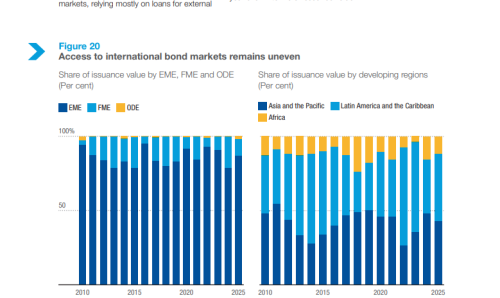
The report also finds that roughly half of developing countries still lack meaningful access to international bond markets despite decades of global financial integration.
Since 1990, emerging market economies have accounted for 87 per cent of sovereign bond issuance by value, compared to 12 per cent for frontier markets and less than 1 per cent for other developing economies.
Africa continues to lag, accounting for only 14 per cent of sovereign bond issuances and 11 per cent of issuance value since 1990. Just 17 African countries have tapped international bond markets over the past decade.
Although financing conditions improved in 2025, borrowing costs remain elevated. Average sovereign bond yields for developing countries stood at 5.7 per cent, above the roughly 5 per cent levels recorded before the Covid-19 pandemic. Frontier market economies and African countries continued to face yields of nearly 8 per cent.
Author
Latest News






Advertisement
More on Business